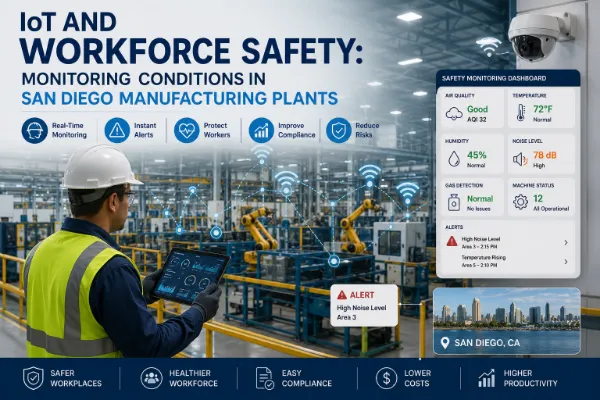
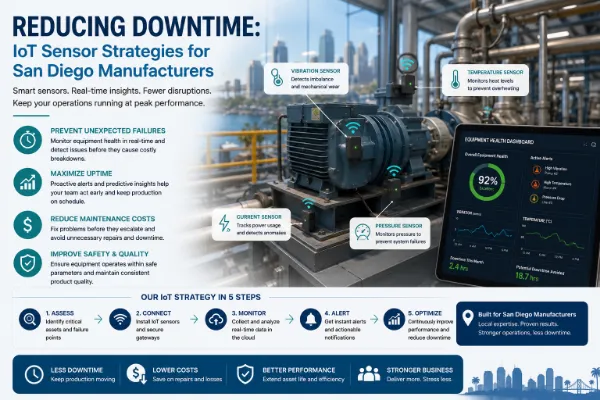
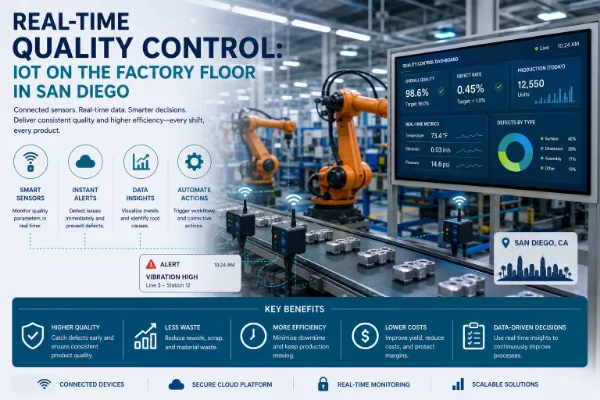
Manufacturers have spent years connecting machines. A newer challenge is connecting the knowledge around those machines.
Maintenance manuals sit in document repositories. Inspection reports live in another system. Experienced technicians carry troubleshooting knowledge that may never be written down. Sensor telemetry streams into dashboards. When a machine behaves abnormally, the person diagnosing it often has to assemble those pieces manually.
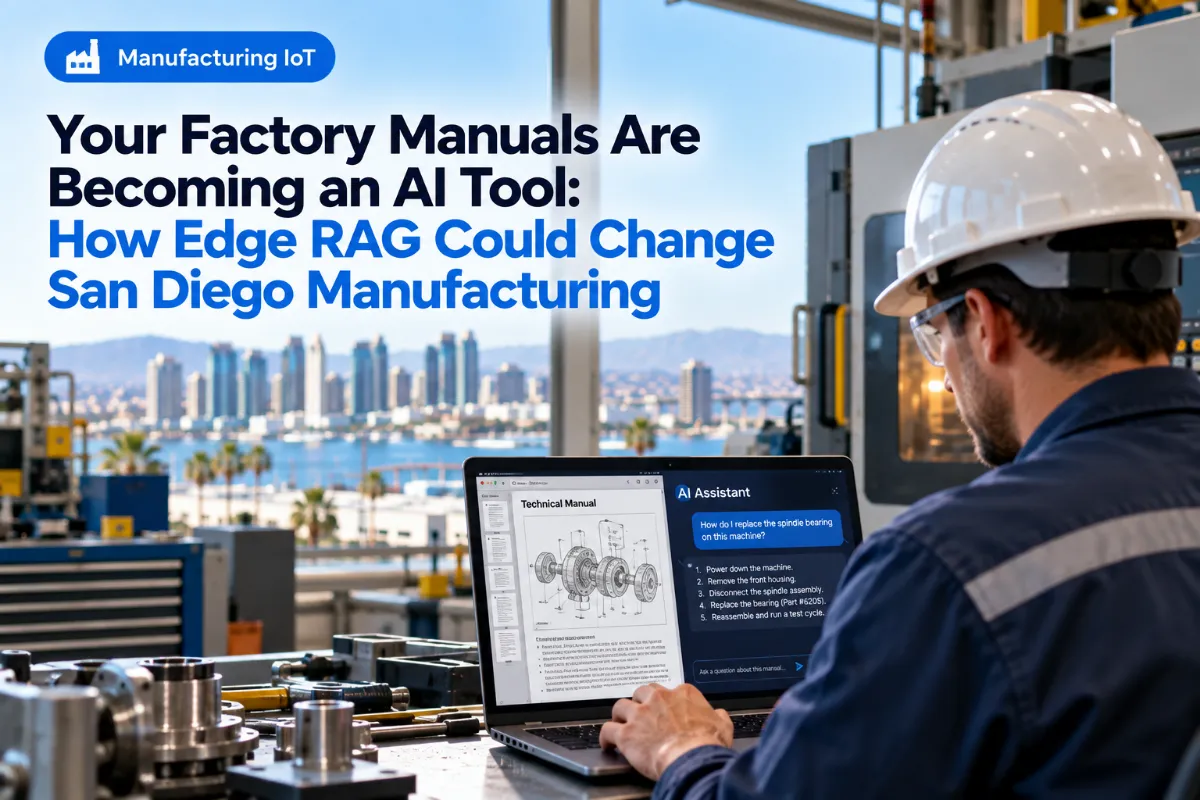
In 2026, edge AI is creating another option: use retrieval-augmented generation, or RAG, to connect technical documentation with live factory information while keeping the workload on local industrial computing infrastructure.
A Qualcomm and Qt FactoryPulse demonstration provides a useful example. Running on a Dragonwing IQ-9075 edge platform, the system combines vision AI, speech recognition and generative AI. A related Qualcomm demonstration uses RAG with manuals, maintenance records and inspection reports to assist predictive-maintenance workflows and answer operator questions grounded in factory information.
For San Diego manufacturers, the interesting question is not whether a chatbot belongs on the factory floor. It is whether fragmented operational knowledge can become easier to retrieve at the exact moment a technician needs it.
Predictive maintenance attempts to identify equipment degradation or failure risk from operational data. RAG addresses knowledge retrieval.
Imagine a vibration-monitoring system flags an unusual condition on a motor. The technician still needs context. What does the manufacturer manual say? Has this machine produced the same pattern before? What was replaced during the last service? Is there an inspection note related to the bearing?
A RAG system can search approved documents and retrieve relevant passages before generating a response. That is fundamentally different from asking a general-purpose model to guess how the machine works.
Our existing article on predictive-maintenance ROI for San Diego manufacturers covers the sensor and business-case side. RAG can become the knowledge layer that helps people act on those signals.
Manufacturing information can be sensitive. Process documents, equipment configurations, quality records and maintenance history may contain proprietary operational knowledge.
Running models and retrieval locally can reduce the need to transmit that information to external services. It can also keep the knowledge tool available in facilities with limited or intentionally restricted internet connectivity.
| Factory Information | Possible RAG Use |
|---|
| Equipment manuals | Retrieve troubleshooting and service procedures |
| Maintenance records | Surface previous failures and repairs |
| Inspection reports | Find prior observations related to an anomaly |
| Standard operating procedures | Guide operators to approved steps |
| Live telemetry | Add current machine context |
| Quality documentation | Explain specifications and inspection requirements |
A RAG system is only as useful as the information it retrieves.
Factories frequently have multiple versions of manuals, scanned PDFs, inconsistent equipment names and maintenance notes written in different formats. If the knowledge base contains outdated procedures, an AI interface can make the bad information easier to retrieve.
That means the first manufacturing RAG project should begin with document governance rather than model selection.
Teams need to identify authoritative sources, remove obsolete versions, map documents to specific assets and define who is allowed to update the knowledge base.
Suppose a plant has six similar pumps. A technician asks, "What was the last repair on this pump?" The system must know which pump is being discussed.
Factories often have different equipment identifiers across maintenance software, PLC tags, drawings and physical labels. RAG exposes that inconsistency quickly.
A reliable implementation should map asset IDs across systems. QR codes, RFID tags or the operator interface can provide context so a query is automatically associated with the correct machine.
This is one reason Manufacturing IoT in San Diego should be viewed as a data architecture problem rather than a collection of sensors.
A manual can explain what a temperature alarm means. Live telemetry can show whether the temperature has been rising for three hours.
Combining retrieval with current machine context creates a more useful operator experience. The system might retrieve the approved troubleshooting procedure, display recent sensor trends and surface the last maintenance event for the affected asset.
The generative model should not invent a diagnosis. Its role can be to organize and explain retrieved information so a technician can investigate more efficiently.
RAG is not limited to maintenance.
A quality technician investigating a defect may need the current specification, inspection procedure, prior nonconformance reports and machine settings associated with the production run.
Our existing article on IoT quality control and traceability for San Diego manufacturers covers how connected production data can improve traceability. RAG can make that historical information easier for people to query.
The same concept can support our previously covered real-time quality-control IoT workflows by connecting an automated defect alert with the documentation needed to investigate it.
FactoryPulse also demonstrates speech recognition alongside edge AI. Voice interfaces can be useful when an operator's hands are occupied or when navigating multiple screens would interrupt a task.
A technician could ask for the torque specification for a component or request the last maintenance record while standing beside the machine.
However, industrial environments are noisy. Speech interfaces need to be tested around actual equipment, hearing protection and local terminology. A feature that performs well in a conference room may fail beside compressors or machining equipment.
- Use approved sources only. Do not mix unverified internet material into a safety-critical factory knowledge base.
- Show the source. Operators should be able to see which manual, record or procedure supports an answer.
- Control document versions. Obsolete instructions should not compete with current procedures.
- Limit authority. An AI assistant should not silently change machine settings or maintenance records.
- Log important interactions. Organizations should be able to review how the system is being used and where retrieval fails.
Retrieval grounding can make responses more relevant, but it does not guarantee correctness.
The model can misinterpret a retrieved passage, combine information incorrectly or answer a question that the available documents do not support. A trustworthy interface should be able to say that it does not have enough information.
For maintenance or quality decisions, citations to the underlying factory document are important. The technician should be able to verify the source before taking consequential action.
A common mistake would be attempting to ingest the entire factory document repository on day one.
A better pilot can focus on one equipment family with frequent troubleshooting needs. Collect the current manuals, maintenance history, inspection notes and standard procedures. Normalize asset names. Test real technician questions.
Measure how often the system retrieves the correct source, whether technicians find answers faster and which questions still require expert escalation.
Only then should the knowledge base expand.
The number of questions asked is not a manufacturing KPI.
Useful measures include mean time to diagnose, mean time to repair, repeated faults, technician search time, escalation frequency and first-time fix rate. If the RAG assistant is popular but none of those outcomes improve, the project may not be creating operational value.
This connects directly to our guide on reducing downtime with IoT sensor strategies. Better sensing and better knowledge retrieval should ultimately improve the same operational outcomes.
Documentation rarely contains everything a senior technician knows.
Experienced staff understand recurring failure patterns, unusual sounds, environmental factors and practical diagnostic sequences. Manufacturers can capture some of this knowledge in reviewed troubleshooting notes and approved procedures before it disappears through retirement or turnover.
The goal should not be to replace experienced people with an AI interface. It should be to make validated organizational knowledge available to more people without requiring the same expert to answer every routine question.
A local RAG system may contain valuable intellectual property. Access should reflect job responsibilities.
A maintenance technician may need equipment manuals and service history. A temporary contractor may need a narrower subset. Quality documentation may have different permissions.
Running locally reduces some external exposure, but the edge appliance still needs patching, authentication, backups and monitoring.
San Diego companies do not need a fully autonomous factory to benefit from this approach.
A manufacturer can begin with a single production cell and a small, curated document collection. A medical-device producer can focus on approved equipment procedures. A biotech facility can keep sensitive process documentation within local infrastructure. A machine shop can connect service records with condition-monitoring alerts.
Local organizations researching industrial technology providers can also explore our IndustrialAX Solutions profile and broader industrial directory.
The first wave of manufacturing IoT connected machines. The next wave is connecting the information required to understand those machines.
Edge RAG is interesting because it brings together two datasets that are often separated: what the equipment is doing now and what the organization already knows about it.
If implemented carefully, a technician investigating an anomaly could move from sensor alert to relevant manual section, previous repair and current trend without searching multiple systems.
That is a more practical vision than a factory chatbot answering arbitrary questions. It treats AI as a retrieval and context tool inside an established manufacturing workflow.
For San Diego manufacturers, the competitive value will not come from having the most advanced model. It will come from having cleaner operational knowledge, better asset identity and a system that puts verified information in front of the right person when production is waiting.
Frequently asked questions
Retrieval-augmented generation retrieves relevant information from approved factory documents or data sources and provides that context to a generative AI model before it answers a question.
It can surface relevant manual sections, prior maintenance records, inspection reports and other approved information when a technician is diagnosing equipment.
Local deployment can reduce dependence on external connectivity and help organizations keep proprietary factory information within local infrastructure.
It should be treated as decision support, not unquestioned authority. Users should be able to verify source documents, and established safety procedures and qualified personnel should remain in control.
Start with one equipment family, curate current documents, normalize asset identities, test real technician questions and measure whether diagnosis or repair workflows improve.
Operational measures such as time to diagnose, time to repair, technician search time, escalation frequency and first-time fix rate are more meaningful than the number of chatbot interactions.
Related articles

 Manufacturing IoT