San Diego's next major border crossing is being designed as more than additional pavement and inspection booths. The Otay Mesa East Port of Entry and the transportation systems around it are being built with digital traffic management, border wait-time information, tolling and connected-vehicle capabilities in mind.
That makes the project one of the region's most consequential real-world IoT stories for logistics.
In 2026, California transportation funding included $255.1 million for the Otay Mesa East federal facility, information technology systems and tolling. Caltrans said the intelligent transportation systems will support congestion management, advanced traveler information and border wait-time measurement. A separate $36 million allocation supports the project's technology package.
SANDAG's Advancing Border Connectivity program adds another layer. Its Regional Border Management System is intended to coordinate cross-border transportation operations, while Smart Intersection System deployments use connected-vehicle technologies along corridors serving the border region.
For trucking companies, freight operators and warehouses around Otay Mesa, the opportunity is not simply a faster border. It is a border corridor capable of producing and distributing more operational information.
Cross-border logistics contains uncertainty that ordinary local delivery routes do not. A truck's arrival time can be affected by congestion, inspection conditions, queue length, incidents and activity on both sides of the border.
That uncertainty propagates through the supply chain. A delayed crossing affects driver schedules, warehouse doors, labor planning, customer appointments and downstream deliveries.
Our existing article on IoT and cross-border freight visibility in Otay Mesa examines vehicle and shipment tracking. The new infrastructure story is different: what happens when the corridor itself becomes a source of connected operational data?
SANDAG describes the Regional Border Management System as an advanced transportation-management solution for coordinated cross-border travel. It is being developed as part of the Advancing Border Connectivity project, which focuses on the South Bay and U.S.-Mexico border region.
The system is intended to work with connected-vehicle technologies, smart intersections and integrated corridor-management capabilities.
That matters because border efficiency is not determined by one checkpoint. Traffic approaching a port of entry moves through a network of roads, intersections and queues. A management system can become more useful when it understands conditions across that network.
| Information | Potential Logistics Use |
|---|
| Border wait time | Adjust dispatch and arrival planning |
| Traffic incidents | Reroute or delay departures |
| Intersection conditions | Improve corridor flow awareness |
| Toll information | Include crossing cost in route decisions |
| Vehicle telemetry | Compare fleet status with corridor conditions |
| Charging availability | Coordinate future zero-emission freight operations |
The value increases when public infrastructure data can be combined with a carrier's own telematics and transportation-management system.
Knowing where a truck is does not necessarily tell a warehouse when it will arrive.
A GPS point may show that a vehicle is three miles from the border. Without queue conditions and crossing-time information, that distance has limited predictive value.
A connected freight model combines vehicle location with corridor information. Dispatch software can then estimate arrival based on what is happening ahead rather than distance alone.
That can improve dock scheduling, driver communication and customer updates.
Connected intersections are often discussed as smart-city technology for passenger vehicles. In South Bay, they also have a goods-movement role.
SANDAG's Smart Intersection System is part of the regional transportation technology program and is designed to work with connected-vehicle applications. Better information about traffic conditions can support incident response and corridor management around freight routes.
This connects logistics technology with the broader Smart Cities in San Diego ecosystem. The same roadside infrastructure can influence passenger mobility, transit and commercial freight.
Otay Mesa East is planned as a tolled crossing, with technology used to help manage demand. For logistics operators, tolling turns time and cost into variables that can be evaluated together.
If a crossing option has a higher direct cost but produces a more predictable trip, a carrier may be able to compare the toll against driver time, fuel, missed appointments and equipment utilization.
This is where logistics analytics becomes more useful than a simple cheapest-route calculation.
SANDAG has described a goal of phased opening for the new port of entry in late 2027, while its Advancing Border Connectivity technology project is expected to be completed in 2027.
Logistics companies do not need to wait until opening day to prepare.
- Audit existing telematics. Determine what vehicle location, engine, dwell and driver-status information is already available.
- Clean location data. Geofences around yards, crossings and customer facilities should be accurate enough to measure dwell reliably.
- Connect dispatch and warehouse systems. Arrival predictions are more valuable when dock schedules can respond.
- Define exception workflows. Decide what happens when a border delay exceeds a threshold.
- Track current baseline performance. Record crossing time, idle time and appointment reliability before new infrastructure changes the corridor.
San Diego's freight transition is also becoming connected to charging infrastructure.
In August 2026, the Port of San Diego authorized further progress for a proposed Tidelands Avenue electric truck hub intended primarily for trucks visiting its marine cargo terminals. The proposed project includes a 1,719-kW solar array and a 1.9 MW/7.8 MWh battery system.
California also announced funding in July 2026 for a new Otay Mesa facility with eight pass-through charging lanes designed to incorporate medium-voltage megawatt charging infrastructure.
Electric freight therefore adds state of charge, charger availability, charging duration and energy price to the logistics dataset.
San Diego's goods movement network connects marine terminals, border crossings, warehouses and regional highways. Yet each part of the trip can have its own technology platform.
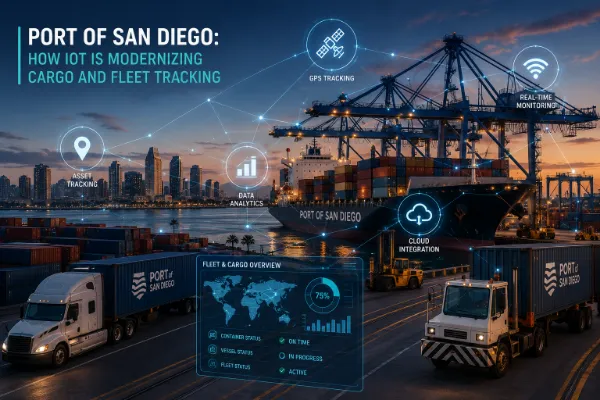
Our article on IoT cargo and fleet tracking at the Port of San Diego covers the maritime side. The long-term opportunity is better continuity between port, road and border information.
A carrier moving cargo between the Port, an Otay Mesa warehouse and Mexico should not have to treat each segment as an unrelated digital environment.
Border uncertainty is particularly important for temperature-sensitive food, pharmaceutical and life-sciences shipments.
For these operators, a delay is not simply a scheduling problem. It can affect remaining refrigeration capacity, product temperature exposure and delivery windows.
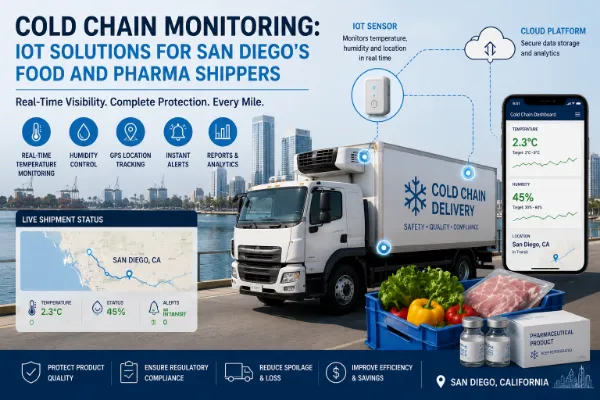
Connected corridor information becomes more useful when combined with shipment-condition monitoring. Our San Diego cold-chain IoT guide examines how temperature and shipment telemetry can provide that second layer of visibility.
A dispatcher does not need another screen showing twenty live feeds. The useful outcome is an exception or recommendation.
If border wait times rise sharply, the system should identify affected loads. If an expected arrival moves by 45 minutes, the warehouse should know which dock appointment needs attention. If a truck's dwell time exceeds a normal range, the event should be recorded automatically.
The best connected-freight system reduces the amount of information a person has to assemble manually.
Connected corridors involve public agencies, private carriers and technology providers. Not every participant should see every piece of fleet data.
Organizations should distinguish between information needed for traffic management, information needed for commercial operations and information that is sensitive to a specific carrier or customer.
APIs and data-sharing agreements should define access, retention, security and permitted use. A technically interoperable system can still fail if participants do not trust how information is governed.
Technology should be evaluated against operational outcomes rather than device counts.
- Average and variability of border crossing time
- Truck idle time
- Appointment reliability
- Driver hours consumed by queues
- Fuel or energy consumed while waiting
- Accuracy of estimated arrival times
- Number of manual dispatcher interventions
Variability is particularly important. A route that averages 45 minutes but sometimes takes three hours can be harder to plan than a route that consistently takes an hour.
The physical infrastructure is enormous, but the digital layer may have an outsized effect on day-to-day freight operations.
For San Diego logistics companies, the best preparation is not buying a new IoT platform simply because the border is becoming smarter. It is making sure existing fleet, dispatch and warehouse data is clean enough to use the new corridor information when it becomes available.
The companies positioned to benefit will know their current crossing times, dwell patterns and appointment performance. They will have systems capable of ingesting external data. Most importantly, they will have operating procedures that turn a change in border conditions into a specific dispatch action.
That is the real promise of a connected freight corridor: not knowing more about traffic, but making better logistics decisions before a truck reaches it.
Frequently asked questions
It is a new land port of entry being developed for the San Diego-Baja California region, connected by State Route 11 and designed to serve passenger and commercial vehicles.
It is a transportation-management system being developed by SANDAG to support coordinated operations in the border region, including the new Otay Mesa East Port of Entry.
Border wait times, incidents and corridor conditions can be combined with fleet telematics to improve arrival estimates, dispatch decisions, dock scheduling and customer updates.
Connected intersection technology can provide information and support coordinated traffic operations on corridors serving South Bay and the border region.
SANDAG has described a goal of a phased opening in late 2027, although major infrastructure schedules can change as construction and commissioning progress.
They can improve telematics data quality, establish accurate geofences, integrate dispatch and warehouse systems, measure current crossing performance and prepare systems to consume external corridor information.
Related articles

 Logistics & Transportation