For San Diego County growers, irrigation is no longer simply a question of when to turn the water on. The more valuable question is how much water the root zone actually needs, where it is needed, and whether yesterday's irrigation reached the crop effectively.
That shift is turning soil sensors, connected irrigation controllers, weather data and field analytics into practical agricultural tools. The technology is particularly relevant in San Diego County, where growers manage valuable crops under persistent water-cost and climate pressures.
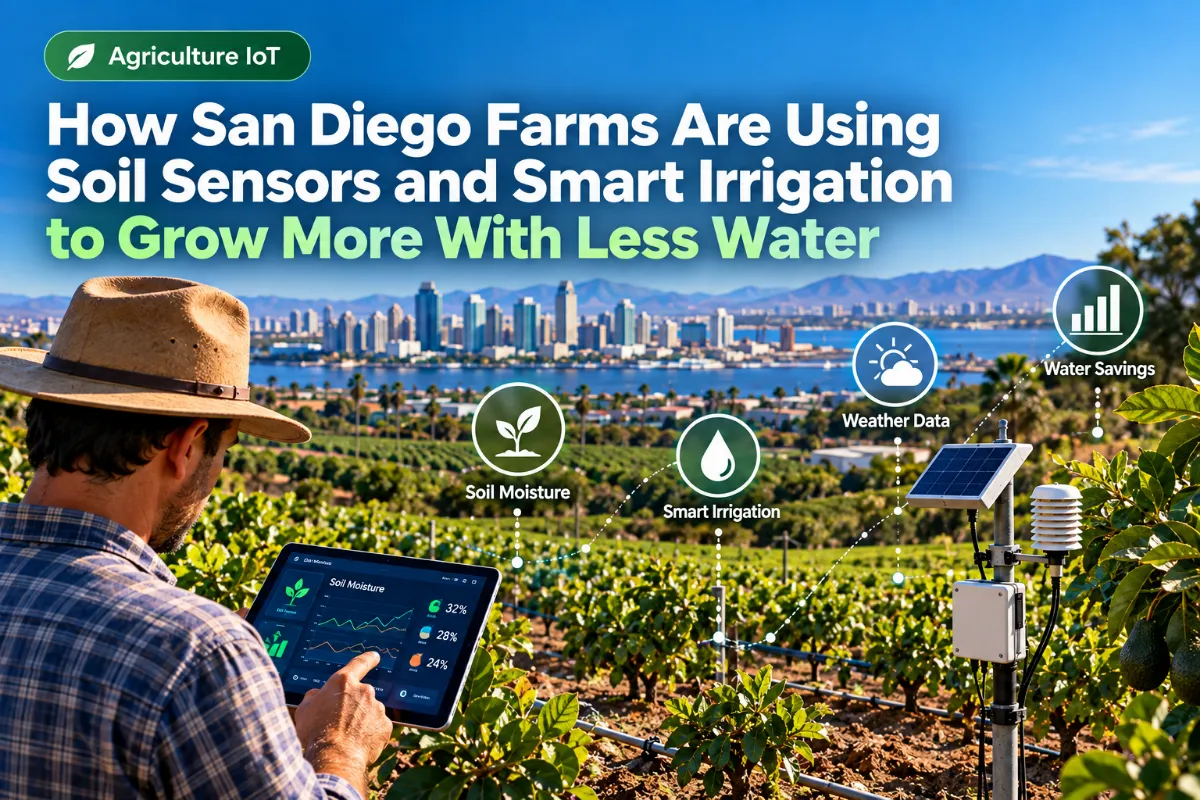
A useful example is the County of San Diego's 2026 CropSWAP demonstration at Grangetto Ranches in Escondido. The project replaced 155 older avocado trees with improved rootstocks planted at higher density and monitors soil moisture and water use at both the project and a nearby control site. Early results reported by the County estimated 108,680 gallons of water savings compared with the control site.
The lesson is bigger than one avocado orchard. Connected agriculture becomes valuable when sensors help a grower make a specific decision rather than simply producing another dashboard.
Many discussions about agricultural IoT focus on massive row-crop operations. San Diego County presents a different environment. Farms can contain orchards, nurseries, specialty crops, livestock operations and high-value production on relatively constrained acreage. Terrain and microclimates can also change considerably across short distances.
That makes field-level measurement particularly useful. A weather reading several miles away may not accurately represent conditions around a hillside avocado block. Soil on one portion of a property may retain moisture differently from another. A fixed irrigation schedule cannot see those differences.
Connected sensors can.
Our broader guide to Agriculture IoT in San Diego covers the technologies being deployed across the sector. The more important implementation question for an individual farm, however, is which measurements can change an irrigation or crop-management decision.
A useful smart irrigation deployment does not require sensors everywhere. It requires sensors in representative locations, reliable communications and a clear process for turning measurements into irrigation decisions.
Soil moisture probes can show how water moves through the root zone after irrigation. When sensors are installed at multiple depths, growers can see whether irrigation is wetting the active root area or moving below it.
Soil data tells a grower what happened in the ground. Flow data helps explain what happened in the irrigation system. An unexpected increase in flow can indicate a broken line, damaged emitter or valve problem.
Temperature, humidity, rainfall, solar radiation and wind influence crop water demand. Weather data becomes particularly useful when it is combined with soil measurements rather than treated as an independent dataset.
The controller is where monitoring can become action. Depending on the system, irrigation schedules can be adjusted remotely or automatically according to defined conditions.
| Operational Issue | IoT Measurement | Potential Business Value |
|---|
| Over-irrigation | Root-zone moisture | Lower unnecessary water use |
| Broken irrigation line | Flow anomaly | Earlier leak detection |
| Uneven irrigation | Multiple moisture zones | Better crop consistency |
| Changing weather | Local weather station | More responsive scheduling |
| Remote fields | Connected sensors and alerts | Fewer unnecessary inspection trips |
One of the easiest ways to waste money on agricultural IoT is to buy devices before understanding field variability.
San Diego growers can review our analysis of soil and climate sensors for avocado and citrus groves and our precision irrigation guide for related implementation considerations.
- Choose one expensive problem. Start with excessive water use, difficult irrigation scheduling or leak detection.
- Establish a baseline. Record existing water use, irrigation frequency and labor requirements.
- Instrument a representative area. Begin with well-placed soil sensors, flow monitoring and weather inputs.
- Create action thresholds. Decide who receives an alert and what action follows.
- Measure a complete growing period. Compare results with the baseline before expanding.
Ground sensors provide precise information at specific locations, while satellite and aerial imagery can identify larger spatial patterns. The strongest model is sensor fusion. Our analysis of AIoT, satellite data and water management for San Diego growers examines that combination.
Agricultural IoT often operates in places where ordinary office networking assumptions fail. Before choosing a platform, growers should determine how devices communicate, how frequently they transmit and what happens during connectivity loss.
San Diego is also modernizing how water is measured and managed. That creates a connection between field technology and broader smart utility infrastructure in San Diego.
- Buying sensors before defining the decision.
- Ignoring calibration and maintenance.
- Automating too quickly.
- Using a single measurement depth.
- Failing to assign ownership for alerts.
The next phase will be less about adding sensors and more about combining soil moisture, flow, weather, crop imagery and equipment data intelligently. San Diego's strongest opportunity is to use connected measurement to make expensive resources more productive.
For local growers, the standard should be straightforward: start with a costly decision, measure what is happening now, use sensors to improve that decision, and expand only when the numbers justify it.
Frequently asked questions
Soil moisture sensors can measure conditions at different depths in the root zone, helping growers determine when irrigation is needed and whether applied water is reaching the intended depth.
It can help reduce unnecessary irrigation by showing actual field conditions instead of relying entirely on fixed schedules.
For irrigation-focused projects, a practical starting point is usually root-zone soil moisture monitoring, irrigation flow measurement and reliable local weather data.
No. Basic sensor thresholds, alerts and remote controls can deliver substantial value.
Compare water consumption, irrigation labor, inspection time, leak incidents and relevant crop performance against a pre-deployment baseline.
A common mistake is installing many sensors without defining what decisions their data will change.
Related articles
 Smart Buildings