San Diego's industrial base looks different from most manufacturing hubs. Instead of a single dominant sector, the region runs on a dense cluster of defense contractors, biotech and life sciences manufacturers, and precision equipment makers, General Atomics, Northrop Grumman's local operations, and BAE Systems' shipyard among the defense names, alongside a life sciences manufacturing base built around companies producing everything from diagnostic instruments to biologics. What these operations share is zero tolerance for unplanned downtime. A halted production line at a biologics facility can mean a lost batch worth millions. A grounded piece of test equipment at a defense contractor can delay a program with contractual penalties attached. That shared intolerance for surprise failures is why San Diego's industrial sector has become an early adopter of a genuinely new category of maintenance technology: agentic AI systems that don't just flag a problem, they plan and execute the fix.
Predictive maintenance itself isn't new. Vibration sensors, thermal imaging, and current monitoring on rotating equipment have been standard practice in well-run plants for years. What's changed heading into 2026 is the layer sitting on top of that sensor data. Earlier predictive maintenance systems analyzed patterns and alerted a technician that a bearing was likely to fail within a defined window. The technician still had to interpret the alert, check parts inventory, and manually schedule the repair.
Agentic AI systems compress that entire sequence. When sensor data indicates a developing fault, the system doesn't just alert someone, it evaluates the failure mode, checks whether the required replacement part is in inventory, generates a prioritized work order, and schedules the technician, all without a human initiating each step. For San Diego manufacturers operating under tight production schedules or regulatory documentation requirements, that compression from detection to action matters as much as the detection itself.
San Diego's defense manufacturing operations run on tight, often penalty-bearing delivery schedules tied to government contracts. Equipment downtime doesn't just cost repair dollars, it can trigger schedule slippage that has contractual consequences. IIoT-enabled predictive maintenance on CNC machining centers, test equipment, and specialized fabrication tools gives these operations the kind of continuous equipment health visibility that traditional preventive maintenance schedules, fixed calendar-based service intervals, can't match.
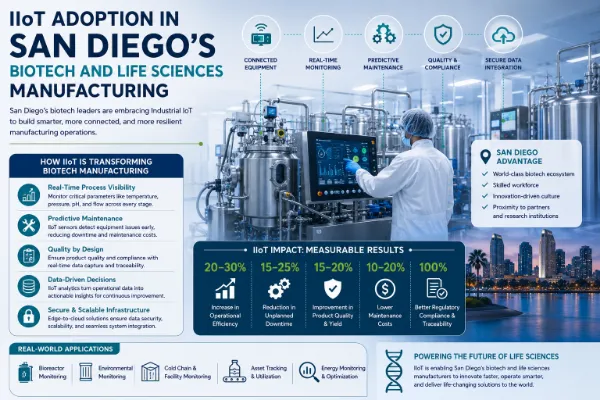
For San Diego's life sciences manufacturers, a bioreactor, a cleanroom HVAC system, or a critical utility failure doesn't just stop production, it can invalidate an entire batch that was days or weeks into a production cycle. The financial exposure from a single lost batch frequently dwarfs the cost of the sensor infrastructure needed to prevent it. This is why biotech manufacturers have become some of the most aggressive adopters of IIoT predictive maintenance in the county, particularly for utilities considered critical to Good Manufacturing Practice compliance.
A typical deployment layers several technologies together rather than relying on a single sensor type:
- Vibration and acoustic sensors on rotating equipment such as pumps, compressors, and motors, now inexpensive enough that industrial-grade units cost under a few dollars per unit in volume deployment.
- Thermal monitoring on electrical panels and critical process equipment, catching developing connection or insulation issues before they cause a failure or safety incident.
- Edge computing gateways that process sensor data locally, reducing the latency between a developing anomaly and an actionable alert, which matters when a fault can progress from detectable to critical within hours.
- Integration with existing CMMS platforms, so the agentic layer can actually generate and route work orders within the maintenance management system a plant already uses, rather than operating as a disconnected dashboard.
The infrastructure backbone connecting these components matters as much as the sensors themselves. Publish-by-exception messaging architectures, which only transmit data when a meaningful change occurs rather than continuously streaming raw readings, prevent the network congestion that has historically made large-scale sensor deployments impractical on older industrial sites.
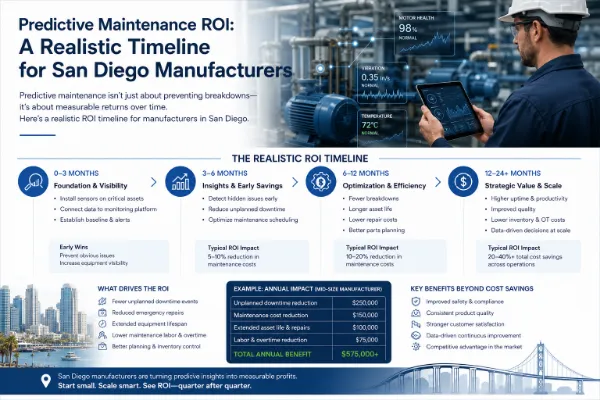
The return on investment case for IIoT predictive maintenance rests on a few consistent, well-documented benefits:
- Reduced unplanned downtime, commonly cited in the 25 to 30 percent range across manufacturing deployments, translating directly into preserved production capacity.
- Extended equipment lifespan, since catching developing issues early prevents the cascading damage that turns a minor repair into a major overhaul.
- Reduced expedited parts and overtime labor costs, since planned maintenance during scheduled downtime windows is significantly cheaper than emergency repairs requiring rush shipping and after-hours labor.
- Better compliance documentation, particularly relevant for San Diego's regulated biotech manufacturers, since continuous sensor data creates an audit trail supporting equipment qualification and validation requirements.
Manufacturers who successfully deploy this technology tend to follow a deliberate, staged approach rather than instrumenting an entire facility at once.
- Identify the highest-consequence equipment first. For a biotech manufacturer, that's typically critical utilities and bioreactors. For a defense contractor, it's often the equipment on the tightest production schedule or with the longest replacement lead time.
- Deploy basic condition monitoring before layering on AI. Getting reliable vibration and thermal data flowing consistently is a prerequisite for any predictive or agentic capability, not a step that can be skipped.
- Integrate with the existing CMMS before expanding sensor coverage. A predictive system generating alerts nobody acts on because they're stuck in a separate dashboard delivers no value regardless of how sophisticated the underlying AI is.
- Introduce agentic automation incrementally, starting with automated work order generation before moving to more autonomous scheduling and parts ordering, giving maintenance teams time to build trust in the system's recommendations.
- Expand to secondary equipment only after the initial deployment has demonstrated reliable, actionable results on the highest-priority assets.
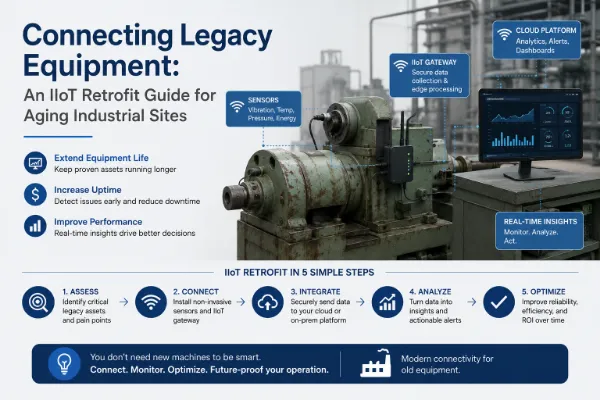
Legacy equipment retrofit complexity. Many San Diego industrial sites, particularly older buildings in Kearny Mesa and Sorrento Valley's industrial corridors, run equipment that predates any consideration of IIoT connectivity. Retrofitting sensors onto legacy machinery without native connectivity requires careful planning around power, mounting, and network access that newer facilities don't face.
Operational technology and IT convergence risk. As industrial systems become more connected, they also become more exposed. Manufacturing was among the most targeted sectors for cyber incidents in recent industry threat reports, and San Diego's defense contractors in particular face elevated scrutiny around cybersecurity given the sensitivity of their operations. Zero-trust network architecture and strict segmentation between operational technology and general IT networks are non-negotiable, not optional add-ons.
Data quality before AI value. Feeding poor-quality or inconsistently calibrated sensor data into an AI model produces unreliable recommendations that erode maintenance team trust quickly. Data quality management, sometimes described as refining raw sensor data into a business-ready state before it reaches any predictive model, deserves as much attention as the AI capability itself.
Workforce skill gaps. Successfully running an IIoT predictive maintenance program requires expertise spanning IoT infrastructure, cloud platforms, AI, and traditional industrial maintenance, a combination many San Diego manufacturers are still building internally rather than having in place already.
The clearest trajectory for San Diego's industrial sector is toward increasingly autonomous decision-making, systems that don't just recommend a maintenance action but execute multi-step resolutions with minimal human intervention, reserving human review for exceptions and high-consequence decisions. Edge AI inference, running models directly on plant-floor hardware rather than relying on constant cloud connectivity, is also becoming standard, both for latency reasons and because it keeps sensitive operational data on-site, a meaningful consideration for defense manufacturers operating under strict data handling requirements.
For San Diego's industrial base, the direction is clear: the manufacturers treating equipment health as a continuously monitored, proactively managed system, rather than something addressed after a failure occurs, are the ones best positioned to protect the production schedules and compliance requirements their businesses depend on.
For more detail, see our coverage of IIoT adoption across San Diego's biotech and life sciences manufacturing sector, our breakdown of predictive maintenance ROI timelines for San Diego manufacturers, and our practical guide to retrofitting IIoT onto legacy equipment and aging industrial sites. San Diego-based IndustrialAx Solutions is among the local firms active in this space. Explore more coverage in our Industrial IoT category or the San Diego industrial IoT hub.
Frequently asked questions
Traditional predictive maintenance analyzes sensor data to alert a technician that a failure is likely, but the technician still handles diagnosis, parts checks, and scheduling manually. Agentic AI systems extend that process further, automatically evaluating the fault, checking part availability, generating a work order, and scheduling the repair with minimal human input required at each step.
No. While large operations with high downtime costs see the fastest, most dramatic returns, mid-size San Diego manufacturers in precision machining, food and beverage production, and other sectors are also adopting scaled-down versions of this technology, often starting with a handful of sensors on their most critical equipment.
Continuous sensor monitoring creates a detailed, timestamped record of equipment condition and maintenance actions, which supports the documentation requirements associated with Good Manufacturing Practice compliance and equipment qualification, an advantage over periodic manual inspection logs.
Most manufacturers start with a pilot deployment on a small number of high-consequence assets rather than a facility-wide rollout, which keeps initial costs manageable while still generating measurable data on downtime reduction before committing to a larger investment.
Retrofit sensor kits, external vibration and thermal sensors that attach to existing equipment without requiring integration into the machine's original control system, allow older equipment to be monitored without a full replacement. This is a common approach on San Diego's older industrial sites where replacing legacy machinery isn't practical.
Network segmentation separating operational technology from general IT systems, encrypted data transmission, secure device authentication, and regular vulnerability assessments are considered baseline requirements, not optional extras, particularly for defense contractors subject to additional regulatory scrutiny.
Related articles


 Industrial IoT (IIoT)