Industrial AI has spent several years moving from centralized servers toward the factory floor. In 2026, a more consequential transition is underway: useful AI processing is moving into smaller industrial controllers, gateways, machine-vision systems and human-machine interfaces.
That matters in San Diego because one of the companies pushing this transition is headquartered here. Qualcomm introduced its Dragonwing IQ-2390 in September 2026 as an industrial edge processor intended for compact systems that combine application processing, machine vision, AI acceleration and real-time networking. The significance is not simply a new chip. It is the possibility of putting more intelligence into equipment that historically handled narrower control or connectivity tasks.
For San Diego manufacturers, biotech facilities, defense suppliers, energy operators and industrial technology companies, this creates a practical question: which industrial decisions benefit from being made close to the machine rather than in a remote cloud environment?
An industrial gateway once had a relatively straightforward job. It translated protocols, collected machine data and passed information to another system. A human-machine interface displayed status. A programmable logic controller handled deterministic control. A separate computer might run vision or analytics.
Those boundaries are becoming less rigid. Modern industrial edge platforms can combine several workloads while still supporting the reliability, networking and environmental requirements of industrial deployments.
Qualcomm says the IQ-2390 integrates CPU, graphics, AI inference, vision processing, a RISC-V microcontroller and dual Gigabit Ethernet with Time-Sensitive Networking. It is designed for applications including industrial HMIs, PLCs, CNC equipment, gateways, machine vision, energy systems and building controls.
This direction complements the broader Industrial IoT ecosystem in San Diego, where connected equipment increasingly has to do more than transmit telemetry.
Cloud computing remains valuable for fleet-wide analytics, long-term storage and business applications. But an industrial process can generate information faster than it is practical or desirable to send everything elsewhere.
A vision system inspecting products may process many images per second. A machine may produce vibration, temperature, current and motion measurements continuously. Sending every raw signal to the cloud can add bandwidth cost, latency and dependency on external connectivity.
Edge processing changes the data flow. The local system can analyze high-volume information and transmit the result, exception or summarized trend.
| Industrial Workload | Why Edge Processing Helps | What Can Be Sent Upstream |
|---|
| Machine vision | Images can be evaluated locally | Defect result and selected evidence |
| Condition monitoring | High-frequency signals stay near equipment | Anomalies and trends |
| Operator assistance | Local documentation can remain available | Selected operational records |
| Safety monitoring | Low-latency detection is useful | Events requiring review |
| Industrial control | Deterministic timing remains local | Production and performance data |
San Diego's industrial base includes biotech and life sciences, defense and aerospace supply chains, electronics, medical devices, energy infrastructure and specialized manufacturing. That diversity changes the edge-computing opportunity.
A biotech operation may care about process consistency, environmental conditions and data governance. A machine shop may prioritize equipment uptime and dimensional quality. An energy installation may need reliable operation across wide temperature ranges. A defense supplier may have stricter requirements around local data handling.
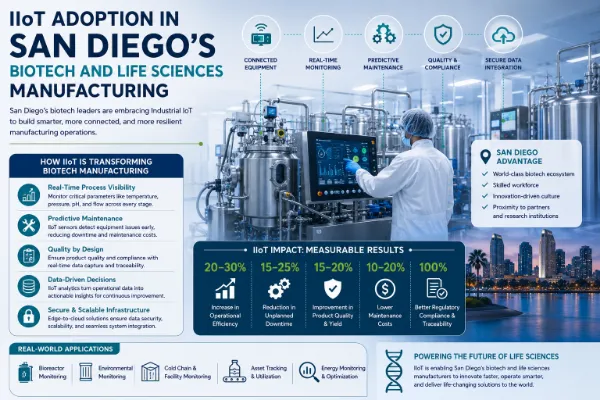
Our existing analysis of IIoT adoption in San Diego biotech and life-sciences manufacturing shows why industrial connectivity should be evaluated against the operating environment rather than deployed as a generic technology stack.
Industrial systems often accumulate computers. One device handles visualization, another performs vision inference, another serves as a gateway and another supports control. Every additional device introduces procurement, integration, networking, software-maintenance and lifecycle considerations.
More capable edge processors can consolidate some workloads onto fewer platforms. That can reduce physical complexity, but consolidation should not be treated as an automatic goal.
If combining workloads creates a larger single point of failure, the architecture may become less resilient. Engineers should separate functions when safety, deterministic control or availability requirements demand it. The business case should be based on total system complexity, not simply reducing the device count.
AI attracts most of the headlines, but deterministic networking can be equally important in industrial environments.
Ordinary Ethernet traffic does not guarantee that every packet will arrive within a tightly controlled time window. Time-Sensitive Networking adds capabilities intended to make Ethernet more predictable for time-sensitive industrial communications.
That matters when an edge platform is expected to participate in both information processing and operational networks. An AI result may tolerate a small delay. A control workload may not.
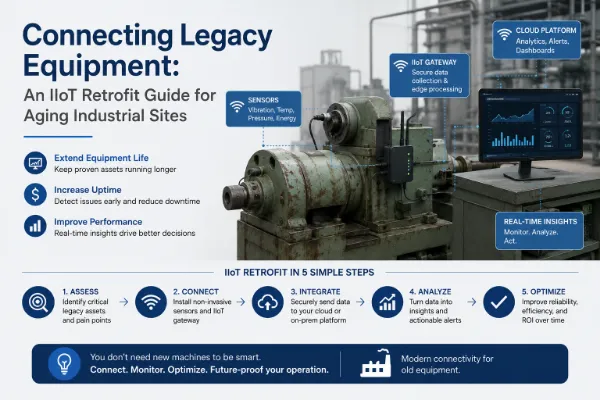
For San Diego organizations modernizing older facilities, networking requirements should be mapped before new AI workloads are introduced. Our IIoT retrofit guide for legacy industrial equipment covers the broader challenge of connecting modern systems to installed machinery.
Machine vision has several characteristics that make local processing attractive. Cameras create large amounts of data, decisions may be needed quickly and many images have little long-term value once a product has passed inspection.
An edge system can analyze imagery near the production line, identify a suspected defect and retain the relevant frame while discarding or summarizing routine images according to the organization's data policy.
This is different from simply installing a camera. The difficult work includes lighting, camera position, representative training data, acceptable false-positive rates and a clear process for what happens when the model is uncertain.
A conventional sensor can fail. An AI model can fail in less obvious ways.
The camera may still be online while lighting changes reduce accuracy. A model trained on one product revision may behave differently after a material or packaging change. An operator may interpret a confidence score as certainty.
Industrial edge deployments therefore need monitoring for the model itself. Teams should define how performance is validated, how models are versioned, how updates are approved and what the system does when AI output is unavailable.
For high-consequence processes, AI should be introduced with appropriate human review and deterministic safeguards rather than becoming an undocumented control dependency.
A smarter gateway is also a more capable computer. That increases the importance of secure boot, device identity, signed updates, access controls and asset inventory.
Industrial operators should know which software version is running on each edge device, who can update it, which services are exposed and what network resources it can reach.
This is especially relevant as connected-device requirements evolve. Our article on IoT security requirements affecting San Diego device makers provides additional context for product teams.
- Find a decision with measurable delay or labor cost. Examples include manual visual inspection, repeated troubleshooting or high-frequency condition monitoring.
- Determine the required response time. If an answer can wait several minutes, cloud processing may be sufficient. If milliseconds or local continuity matter, edge processing becomes more compelling.
- Measure the raw data volume. High-volume vision and sensor workloads can strengthen the case for local filtering.
- Define failure behavior. Decide what happens if the model, sensor, network or edge computer becomes unavailable.
- Run alongside the existing process. Validate the system before making it operationally authoritative.
- Calculate total cost. Include engineering, integration, model maintenance, cybersecurity and lifecycle support, not only hardware.
The regional ecosystem includes technology vendors and industrial integration expertise. Readers researching local providers can start with the Qualcomm company profile and IndustrialAX Solutions profile in our directory.
The more important procurement question is whether a provider understands the process being improved. Industrial projects fail when a technically impressive platform is deployed without sufficient understanding of machine behavior, maintenance practices and production constraints.
The industrial cloud is not disappearing. What is changing is the division of labor.
More data can be interpreted where it originates. Central systems can receive higher-value information rather than every raw signal. Industrial devices can continue performing useful analytics during temporary network disruptions. Sensitive information can sometimes remain on local infrastructure.
For San Diego companies, the practical opportunity is not to put AI into every controller. It is to identify processes where local intelligence improves response time, bandwidth use, privacy, reliability or operator productivity.
The IQ-2390 is notable because it represents how far that capability is moving down the industrial stack. Edge AI is no longer reserved for large industrial computers. It is becoming an architectural option for the compact devices that sit beside machines, meters, cameras and control systems.
That will make the next generation of IIoT less about connecting every device to a distant platform and more about deciding what each device should understand before it sends anything at all.
Frequently asked questions
Industrial edge AI runs AI inference close to machines, sensors or industrial processes rather than requiring every workload to be processed in a remote cloud environment.
It is an industrial edge processor announced in 2026 for compact systems such as industrial HMIs, gateways, machine-vision systems, PLC-related applications and energy-management equipment.
Local processing can reduce latency, bandwidth requirements and cloud dependency while allowing high-volume data such as images or vibration signals to be analyzed near the equipment.
Not necessarily. Deterministic control, safety functions and AI analytics have different requirements. Edge AI can complement established control architectures rather than automatically replacing them.
A strong pilot has a measurable problem such as manual visual inspection, troubleshooting delays or high-volume condition monitoring, along with a clear baseline and failure plan.
Organizations should consider secure boot, authenticated updates, device identity, network segmentation, access control, software inventory and lifecycle patching.
Related articles

 Industrial IoT (IIoT)