San Diego's healthcare sector has already learned, the expensive way, what happens when connected systems and patient data security don't get enough attention. A ransomware attack on Scripps Health cost the system an estimated $112.7 million and forced hospital diversions for a month, while a separate phishing breach at UC San Diego Health exposed data for more than 147,000 patients. Neither incident was specifically about a connected medical device, but both illustrate the underlying risk that makes IoT and HIPAA compliance such a live issue for San Diego providers right now: every additional connected sensor, monitor, or tracking tag is another potential entry point into a network that also holds protected health information, and the regulatory framework governing that risk is genuinely in flux in 2026.
A common misconception is that HIPAA governs medical devices directly. It doesn't, exactly HIPAA applies to covered entities (providers, health plans, clearinghouses) and their business associates, defined as any organization that creates, receives, maintains, or transmits protected health information on a covered entity's behalf. A connected device manufacturer isn't automatically subject to HIPAA simply because it sells hardware to a hospital; the trigger is whether the company's ongoing relationship with that hospital involves accessing, storing, processing, or transmitting patient data which describes a large share of modern IoT medical devices, from remote patient monitors to asset tracking platforms that log which patient a piece of equipment was used with, but not necessarily a company that sells a device with no data relationship afterward.
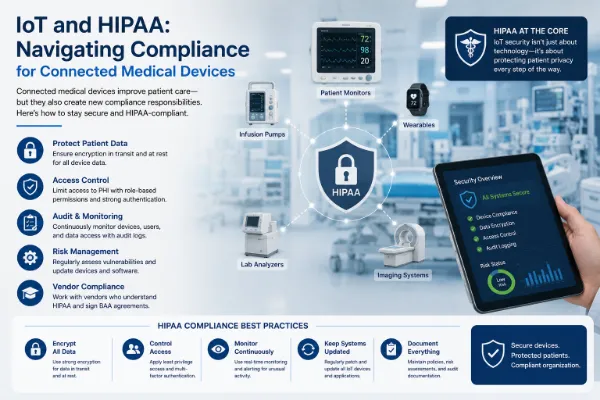
For hospitals and health systems, the practical implication is straightforward: any IoT vendor whose device or platform touches patient data needs a signed Business Associate Agreement, and that agreement increasingly needs to specify concrete security obligations encryption standards, incident notification timelines, vulnerability testing requirements rather than vague, general language.
Here's where it's important to be precise about status, because a lot of vendor marketing material blurs this: HHS's Office for Civil Rights published a Notice of Proposed Rulemaking in January 2025 proposing the most significant overhaul of the HIPAA Security Rule since 2013. As of mid-2026, this remains a proposed rule, not a final one the public comment period closed in March 2025, and while various target dates for finalization have circulated (including May 2026 and, more recently, later in 2027), no final rule has actually been published, and more than one hundred hospital and provider organizations have formally asked HHS to withdraw the proposal, citing an estimated $9 billion first-year compliance cost that smaller and rural providers argue they can't absorb.
That said, the direction of the proposed rule is worth understanding regardless of its final status, because it largely codifies what OCR has already been citing in enforcement actions under the current rule. The core provisions worth tracking:
- Eliminating the "addressable" versus "required" distinction. Under the current rule, some safeguards are technically optional if an organization documents a risk-based reason for skipping them. The proposal would make nearly all listed safeguards mandatory.
- Mandatory encryption. AES-256 for data at rest and TLS 1.2 or higher (with 1.3 preferred) for data in transit, applied to all electronic protected health information without exception.
- Mandatory multi-factor authentication for any system accessing patient data, including systems used to manage connected medical devices.
- Network segmentation requirements specifically calling out that clinical and IoT systems shouldn't share a network with general-purpose systems like CCTV a direct response to how connected devices have historically been treated as an afterthought in hospital network architecture.
- Faster incident reporting business associates would need to notify covered entities within 24 hours of activating an incident response plan, considerably tighter than current norms.
- Regular technical testing, including vulnerability scanning at defined intervals and annual penetration testing, rather than the current rule's vaguer expectation of periodic review.
The practical guidance from most compliance specialists is consistent regardless of when or whether this rule finalizes: these requirements largely reflect what OCR is already treating as best practice in enforcement actions under the existing rule, so organizations implementing them now aren't wasting effort even if the formal deadline keeps slipping.
Separately from HIPAA, the FDA maintains its own cybersecurity expectations specifically for connected medical devices, distinct from but overlapping with HIPAA's data-focused requirements. The FDA issued updated guidance on cybersecurity in medical devices in February 2026, covering premarket submission expectations including secure product development frameworks and software bill of materials documentation the same SBOM concept that's become standard across IoT security regulation more broadly. For San Diego hospitals and the region's substantial medical device manufacturing sector, aligning HIPAA risk analysis with FDA's device-level cybersecurity risk management (built around the ISO 14971 framework) reduces duplicated compliance work considerably, since both frameworks are ultimately asking overlapping questions about the same connected systems.
The single most consistently cited practical obstacle across both HIPAA and FDA compliance efforts is legacy equipment. Industry surveys find that roughly 60% of healthcare organizations lack adequate tools to protect medical devices that simply can't be patched, and a similar share are unable to install standard security monitoring agents on this older equipment at all a real problem given how long medical devices, once purchased, typically stay in clinical service. For a device that can't be updated or directly secured, the accepted approach is documented compensating controls: strict network segmentation that isolates the device from broader hospital systems, monitoring at the network boundary rather than on the device itself, and a documented migration or replacement plan rather than an indefinite exception. Auditors and regulators alike are increasingly expecting to see that documentation specifically, not just an acknowledgment that the problem exists.
San Diego's academic and research infrastructure gives the region a genuine local resource here: UC San Diego operates a dedicated Center for Healthcare Cybersecurity focused specifically on multidisciplinary research and practical solutions for reducing cyber risk in healthcare settings, reflecting how seriously the region's institutions are treating this as a distinct discipline rather than a subset of general IT security. Given the Scripps ransomware incident's scale and the operational disruption it caused, local health systems have real, direct institutional memory of what an inadequately secured network actually costs not as an abstract compliance exercise, but as a documented, expensive local case study.
- Maintain a complete, current asset inventory of every connected device on the network, including ones facilities teams often forget report data externally, like smart infusion pumps or building environmental sensors.
- Segment IoT and clinical device networks from general hospital IT infrastructure, rather than relying on a single flat network.
- Require detailed, specific security language in every BAA with an IoT or connected device vendor encryption standards, breach notification timelines, and audit rights spelled out explicitly, not left to general reference.
- Document compensating controls for any legacy device that can't meet current encryption or patching standards, rather than treating the gap as unaddressed risk.
- Align HIPAA risk analysis with FDA device cybersecurity risk management where both apply, to avoid duplicated audit and documentation work.
Frequently asked questions
No. As of mid-2026, it remains a proposed rule that has not been finalized. HHS published the proposal in January 2025, and while various target finalization dates have been discussed, no final rule has been issued, and industry groups have formally requested it be withdrawn or scaled back.
Not automatically. HIPAA applies when a company has an ongoing relationship with a covered entity that involves accessing, storing, processing, or transmitting patient data a device with no such data relationship after sale generally isn't covered.
HIPAA focuses on protecting patient data specifically, while FDA cybersecurity guidance focuses on the safety and security of the device itself throughout its lifecycle. The two frameworks overlap substantially and can often be addressed through a coordinated risk assessment process.
Document compensating controls network segmentation, boundary monitoring, and a documented migration or replacement timeline rather than leaving the gap unaddressed. Auditors increasingly expect to see this documentation specifically.
No. Most compliance specialists recommend implementing the proposed requirements now, since they largely reflect practices OCR is already citing in enforcement actions under the current rule, regardless of when or whether the formal update is finalized.
It should specify concrete security obligations encryption standards, multi-factor authentication requirements, vulnerability testing cadence, and incident notification timelines rather than general or vague language about data protection.
Related articles

 Healthcare IoT