San Diego County has burned before, and it will burn again. The 2003 Cedar Fire and the 2007 firestorms remain reference points for how quickly wildfire can move through the county's backcountry canyons and into populated areas in North County and East County. What's changed since those events isn't the underlying fire risk, San Diego's combination of dry chaparral, Santa Ana wind conditions, and expanding wildland-urban interface development guarantees that risk remains structural, but the technology available to detect and respond to fire ignition in its earliest minutes. IoT sensor networks, connected weather stations, and automated emergency coordination platforms have become a core part of how the county and its utilities approach wildfire risk in 2026.
San Diego's topography, steep canyons that channel wind and fire spread unpredictably, combined with the explosive growth potential of a Santa Ana-driven fire, means the window between ignition and a fire becoming uncontrollable is often measured in minutes rather than hours. Traditional detection methods, a passerby calling 911 or a lookout spotting smoke, have inherent delays built in. By the time visible smoke is reported and confirmed, a fire in dry, wind-driven conditions may have already grown beyond what initial attack resources can contain.
This is the specific problem that connected sensor networks are designed to close. Rather than waiting for human observation, automated detection systems can identify ignition signatures, smoke, heat, or specific gas signatures, within minutes of a fire starting, often before it's visible to anyone on the ground.
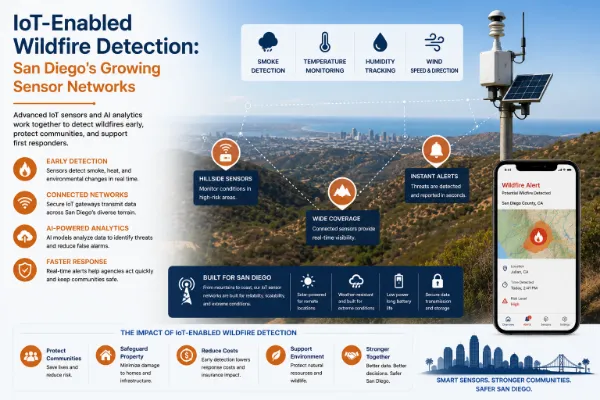
The current generation of wildfire detection infrastructure deployed across San Diego County's high-risk zones combines several distinct technologies rather than relying on a single detection method.
- AI-enabled camera networks positioned on elevated points across the backcountry, continuously scanning for smoke signatures using computer vision trained specifically to distinguish wildfire smoke from dust, fog, and other visual noise that historically caused false alarms in earlier camera-based systems.
- Weather monitoring stations tracking wind speed, humidity, and temperature in real time across the county's fire-prone zones, feeding data that fire agencies use to anticipate where conditions are most dangerous on a given day, information that shapes preemptive resource positioning before ignition even occurs.
- Utility-operated sensor networks, since San Diego Gas & Electric has invested significantly in weather stations and high-definition cameras across its service territory specifically to monitor conditions near power infrastructure, a leading historical cause of wildfire ignition during high-wind events.
- Public safety power shutoff coordination systems, which use the same connected weather and sensor data to inform decisions about when to proactively de-energize power lines in extreme fire weather conditions, balancing fire risk against the real disruption a shutoff causes for residents and businesses.
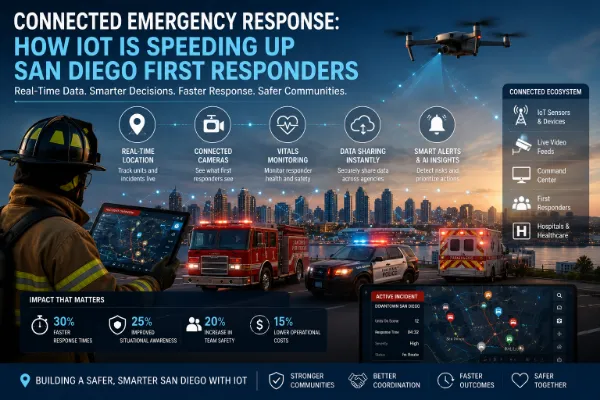
Detection alone doesn't save lives or property, it's the connective tissue between detection and dispatch that determines whether early warning translates into effective action. San Diego's emergency response ecosystem increasingly relies on connected platforms that consolidate data from multiple sources, camera detections, 911 call patterns, weather conditions, and resource availability, into a single operational view for incident commanders rather than requiring dispatchers to manually cross-reference separate systems during the critical early minutes of an incident.
This same connected infrastructure extends into broader public safety applications relevant to San Diego's urban areas, including gunshot detection sensors and environmental sensors capable of identifying gas leaks or air quality hazards, feeding into the same centralized emergency management platforms used for wildfire response. Vibration sensors on aging infrastructure such as bridges can similarly flag structural anomalies before they become emergencies, extending the same real-time monitoring philosophy beyond fire risk specifically.
Traffic signal coordination is another meaningful piece of this puzzle. Connected traffic management systems can automatically clear priority routes for emergency vehicles during a rapidly evolving incident, shaving critical minutes off response times when every minute affects both firefighter safety and containment outcomes.
While public safety technology isn't evaluated purely on financial return, the practical value case for San Diego is substantial and touches multiple stakeholders.
- Reduced property loss. Earlier detection consistently correlates with smaller fire footprints, since initial attack resources have a meaningfully better chance of containing a fire discovered at an acre or two rather than one that has already grown to dozens of acres before detection.
- Insurance market stability. As California's property insurance market has grown increasingly strained in wildfire-prone areas, documented investment in detection and response infrastructure factors into how insurers and regulators assess regional risk, with potential implications for coverage availability in San Diego's backcountry communities.
- Reduced public safety power shutoff duration. More granular, real-time weather and risk data allows utilities to scope shutoffs more precisely to the areas genuinely at elevated risk, rather than de-energizing broader areas out of necessary caution when data is less granular.
- Federal funding eligibility. Programs supporting resilient infrastructure investment have expanded funding availability for exactly this kind of sensor and detection infrastructure, and San Diego County agencies with documented technology deployment plans are better positioned to access that funding.
Unlike a single-business IoT deployment, wildfire detection and public safety sensor networks are typically implemented through coordinated efforts among multiple agencies, so the rollout sequence looks different.
- Prioritize coverage in the highest-risk wildland-urban interface zones first, areas where fire risk and population density both create significant consequence if detection or response is delayed.
- Establish shared data standards across agencies so that camera detections, weather data, and utility sensor information can flow into a common operational platform rather than remaining siloed within individual organizations.
- Integrate detection systems with existing dispatch infrastructure rather than creating a parallel alert system that requires dispatchers to monitor an additional screen during an already high-pressure incident.
- Expand into broader public safety applications, gunshot detection, structural monitoring, air quality sensing, using the same foundational network and command center infrastructure built for wildfire response.
- Continuously refine detection algorithms based on false positive and false negative rates, since camera-based smoke detection systems improve substantially as they accumulate real-world training data specific to San Diego's terrain and vegetation.
Coverage gaps in remote backcountry areas. The same connectivity challenges that affect agricultural sensors in San Diego's rural areas apply to public safety infrastructure. Camera and sensor networks in remote canyon terrain often require the same hybrid satellite and long-range wireless connectivity solutions used in other rural IoT deployments.
False positive management. Early camera-based smoke detection systems struggled with false alarms triggered by dust, fog, or agricultural burning, which erodes trust in the system and creates alert fatigue among monitoring personnel. Modern systems have improved substantially, but ongoing calibration remains an operational requirement, not a one-time setup task.
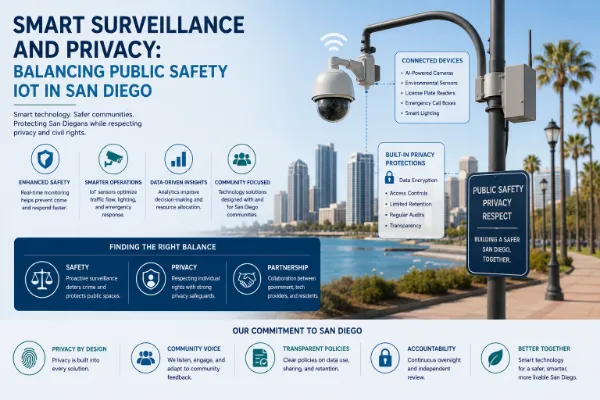
Privacy and surveillance concerns. Camera networks and connected sensors in public spaces inevitably raise privacy questions, particularly given San Diego's own history with public reaction to surveillance-capable infrastructure. Agencies deploying this technology need clear, publicly communicated policies about data use, retention, and access to maintain community trust.
Interagency coordination. San Diego County's emergency response involves multiple fire agencies, law enforcement jurisdictions, and utility companies, and getting these organizations to adopt shared data standards and integrated platforms requires sustained coordination that technology alone doesn't solve.
The next phase of wildfire and public safety technology in San Diego is likely to center on predictive rather than purely reactive capability. Combining historical fire behavior data, real-time weather conditions, and vegetation moisture sensing, emerging systems aim to flag elevated risk zones before ignition occurs, allowing resources to be prepositioned proactively rather than only responding once a fire has already started. Expansion of federal resilient infrastructure funding is likely to accelerate deployment of this next generation of predictive tools across San Diego's highest-risk communities.
For related coverage, see our detailed look at wildfire detection sensor networks across San Diego County, our overview of connected emergency response systems for San Diego first responders, and our discussion of smart surveillance and privacy considerations in public safety IoT. Explore more coverage in our Public Safety category or the San Diego public safety hub.
Frequently asked questions
AI-enabled camera and sensor networks can identify smoke signatures within minutes of ignition, often before a fire is visible to the human eye from ground level or reported through a 911 call, giving fire agencies a meaningfully earlier window to deploy initial attack resources.
Early camera-based detection systems did struggle with false positives from dust, fog, and controlled burns, but modern computer vision models trained specifically on regional conditions have improved accuracy substantially. Ongoing calibration remains necessary as vegetation and environmental conditions change across seasons.
The same connected weather and sensor infrastructure that supports wildfire detection also informs utility decisions about proactive power shutoffs during extreme fire weather. More granular, real-time data allows shutoffs to be scoped more precisely to genuinely high-risk areas, rather than requiring broader precautionary shutoffs when conditions are less clearly understood.
Yes, and this is an active area of public discussion, particularly given the county's own history with surveillance-related public infrastructure debates. Agencies deploying these systems generally need clear, publicly available policies covering data retention, access controls, and the specific purpose limitations governing how camera and sensor data can be used.
Funding and operation typically involve a combination of county and municipal fire agencies, state resources, utility company investment, and increasingly, federal grant programs supporting resilient infrastructure. The specific ownership and operating responsibility varies by system and location.
Some detection camera networks and public alert systems offer public-facing access or notifications, though the specifics vary by system and operating agency. Residents in wildfire-prone areas should check with their local fire agency about available public alert and notification programs specific to their community.
Related articles

 Public Safety