San Diego's public-safety technology network is becoming more connected, but the most important question in 2026 is no longer whether a camera, sensor or database can produce useful information. It is who can access that information, how systems are connected, how long data is retained and what happens when information crosses organizational boundaries.
That makes governance part of the technical architecture.
In July 2026, the San Diego Police Department presented several technologies at a community meeting, including external automated license plate recognition data, community data sharing and counter-unmanned-aircraft technology. The proposals illustrate a broader transition. Public-safety systems are moving from individual devices toward networks in which information can be combined across cameras, databases, private systems and other agencies.
For San Diego, that creates operational possibilities and legitimate governance questions at the same time. The useful approach is not to treat privacy and public safety as separate conversations. A well-designed connected system has to account for both.
An individual license plate reader has a relatively narrow function. Its significance changes when observations can be searched against other records or shared across organizations. A private camera is one thing. A platform through which an organization can voluntarily share information during an incident is another.
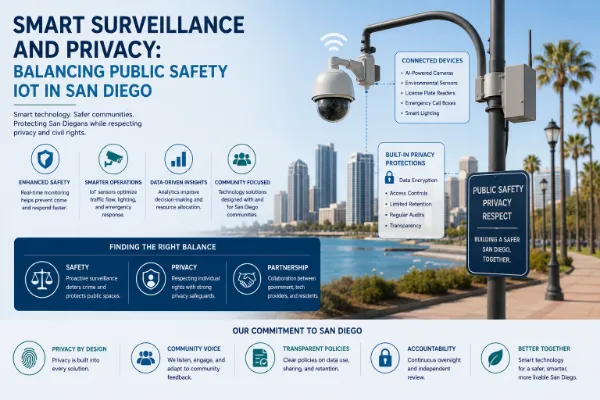
This is why our existing article on smart surveillance, privacy and public-safety IoT in San Diego remains relevant. The next phase is about system relationships rather than simply sensor deployment.
SDPD's technology inventory includes ALPR, unmanned aircraft systems, camera systems, community data sharing and numerous investigative technologies. San Diego also has a Privacy Advisory Board that reviews surveillance-related policies and reports. That governance layer matters because connected technology can change capability without changing the physical sensor.
Automated license plate recognition illustrates the issue clearly. Cameras capture plate observations associated with a place and time. The operational value comes from searching those observations for investigative or situational-awareness purposes.
SDPD's 2026 proposal regarding external ALPR data involves receiving information shared by other law-enforcement agencies and private entities. From a systems perspective, this turns ALPR from a local sensor deployment into a data-integration problem.
Integration requires more than an API. Agencies need rules governing authorized searches, user access, audit logs, retention, sharing and security.
| System Layer | Operational Question | Governance Question |
|---|
| Sensor | Is the observation accurate? | What is collected? |
| Network | Can data arrive when needed? | How is it protected in transit? |
| Database | Can investigators find relevant records? | How long are records retained? |
| Sharing | Can another organization contribute useful information? | Who is permitted to access it? |
| Analytics | Can patterns be identified? | How are results reviewed and audited? |
Community data sharing is notable because public-safety information does not have to originate from a city-owned sensor.
SDPD described a model in which private and public entities can voluntarily provide data during calls for service, critical incidents and investigations, with access revocable by the provider. That can potentially give responders additional context without requiring the city to own every camera or sensor.
But distributed ownership makes identity and permissions more important. The platform needs to know who supplied information, what access was granted, when that permission applies and when it ends.
For organizations participating in such systems, the implementation question should include internal approval. A business should understand who within the organization can authorize sharing and under what circumstances.
Small drones have added another connected-device challenge to public safety. An unauthorized aircraft near an emergency scene can create risk for helicopters, responders and the public.
SDPD's 2026 technology discussion included counter-unmanned-aircraft capability intended to detect illegal or unauthorized drone operations. Detection itself can involve multiple sensor types depending on the implementation, including radio-frequency, optical or other detection methods.
The broader IoT lesson is that public-safety sensing is expanding vertically as well as geographically. Streets, buildings and now low-altitude airspace can all contain connected systems producing operational information.
Not every public-safety IoT system is associated with policing. Environmental sensors, cameras, weather stations and utility infrastructure can support emergency response during wildfire conditions.
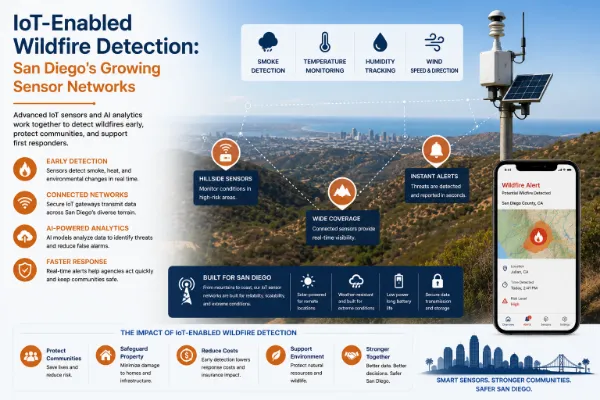
Our coverage of IoT wildfire detection and emergency response in San Diego shows how environmental and infrastructure information can contribute to situational awareness.
The value increases when different data sources can be understood together. A weather reading, camera observation and infrastructure alert may each be limited independently. Combined appropriately, they can give responders a more complete picture.
Smart-city discussions often celebrate interoperability, but public-safety systems need boundaries.
Two systems being technically capable of exchanging information does not mean every user of either system should automatically gain access. Access should be tied to role, purpose and authorization.
Useful controls include least-privilege permissions, multi-factor authentication, audit logs, time-limited access and periodic account review. Sensitive integrations should also document which system is the authoritative source when records conflict.
A sensor error can propagate. An incorrect observation that remains isolated has one impact. The same observation copied into multiple workflows can influence more decisions.
Public-safety technology therefore needs procedures for correcting erroneous records, handling uncertain matches and preserving context around automated outputs.
An ALPR match, computer-vision alert or automated detection should be treated according to the reliability of the underlying technology and the operational policy governing its use. Automation can prioritize attention without eliminating human verification.
Public accountability depends partly on system design. If a platform cannot record who searched for information, what was accessed and when, policy oversight becomes harder.
Audit logs should therefore be considered a core requirement rather than an administrative afterthought. They can support security investigations, internal review and compliance with approved use policies.
San Diego's Privacy Advisory Board publishes recommendations and reviews concerning surveillance technologies, demonstrating why operational reporting needs reliable system records.
- Define the operational problem. Specify what response, investigation or safety problem the technology is intended to improve.
- Map the data flow. Document what is collected, where it goes, who receives it and where it is stored.
- Set access boundaries. Permissions should reflect job responsibilities and approved uses.
- Define retention. Keeping information indefinitely should not be the default simply because storage is inexpensive.
- Build auditability. Important searches and access events should be reviewable.
- Plan for errors. Establish how inaccurate or uncertain automated outputs are verified and corrected.
- Review integrations. New data-sharing relationships can change the capability and risk profile of an existing system.
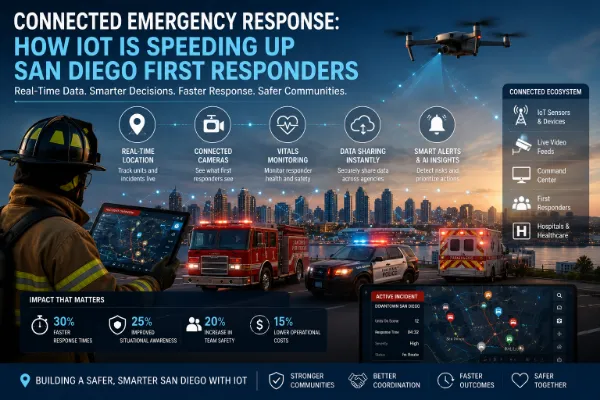
Our guide to connected emergency response for San Diego first responders explores how communications and IoT can improve coordination. The next challenge is ensuring information remains understandable as it crosses systems.
A responder should know whether an alert came from a verified city sensor, a private data source, an automated model or a human report. Provenance helps people judge how much confidence to place in the information.
San Diego is developing connected public-safety capabilities while also maintaining formal surveillance-technology review processes. That combination makes the city a useful case study in how IoT governance evolves alongside technical capability.
The future will likely involve more sensors, more AI and more data sharing. The differentiator will be whether those systems are designed so useful information reaches authorized people without making access broader than necessary.
Public-safety IoT succeeds when technology improves situational awareness and response while remaining understandable, auditable and governable. In 2026, those characteristics are no longer separate from the engineering. They are part of it.
Frequently asked questions
Current discussions include automated license plate recognition data, community data sharing, counter-drone technology and other connected public-safety systems.
Connected systems can share and combine information across devices and organizations, making access controls, retention, audit logs and approved uses as important as the sensors themselves.
It is a model in which participating public or private entities can voluntarily provide information to public-safety organizations under defined circumstances and permissions.
Environmental sensors, cameras, weather data and infrastructure monitoring can improve situational awareness when their information is integrated into emergency workflows.
No. Technical interoperability should be paired with role-based access, approved purposes and data-governance controls.
Measures should relate to the operational objective, while also tracking system reliability, false alerts, access security, auditability and compliance with approved policies.
Related articles

 Public Safety