San Diego occupies an unusual place in the national smart city conversation. Few cities have gone through what San Diego did: a large-scale smart streetlight deployment, roughly 3,200 sensor-equipped streetlights installed starting in 2016, that became a genuine public controversy after residents learned the cameras embedded in those fixtures were being used for police investigations without the public having been clearly informed of that use case upfront. The program was shut down in 2020 amid the backlash, then relaunched years later under a substantially different governance framework, with a dedicated privacy advisory board and clearer public rules about how the data can and cannot be used. That history matters enormously for understanding where San Diego's smart city technology stands in 2026, because it shapes both the technology choices and the transparency requirements that now define nearly every urban IoT deployment in the county.
Most smart city coverage treats urban IoT as a straightforward technology story: sensors go in, data comes out, cities get more efficient. San Diego's experience complicates that narrative in an instructive way. The original smart streetlights program was, from a pure technology standpoint, reasonably sophisticated for its time, capable of monitoring traffic patterns, parking availability, and environmental conditions. What it lacked was public trust, built through transparent governance about exactly how the collected data, particularly camera footage, would be used and by whom.
The relaunched program and the broader smart city initiatives that have followed reflect lessons learned directly from that experience. San Diego's current approach to urban IoT places data governance and public transparency on equal footing with the underlying technology capability, a sequencing that many other cities pursuing similar infrastructure are now studying as they plan their own deployments.
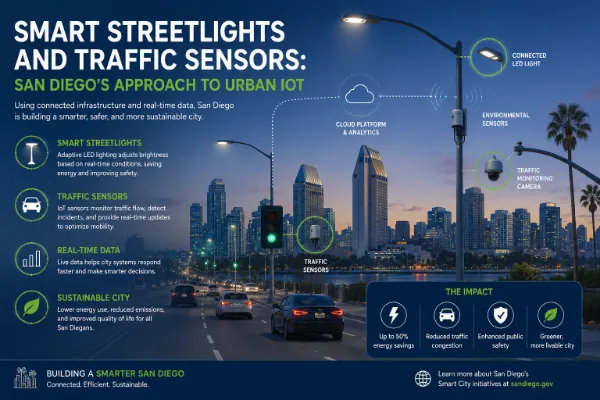
The relaunched streetlight and traffic sensor network continues to support core traffic management functions, adjusting signal timing based on real-time congestion data and providing priority routing for emergency vehicles, while operating under governance rules developed specifically in response to the earlier controversy. Public documentation of data use policies and an active privacy advisory board represent structural changes intended to prevent a repeat of the trust breakdown that shut the original program down.
Beyond streetlights, San Diego has been expanding its use of digital twin technology, continuously updated virtual models of city infrastructure fed by real-time sensor data, to support planning decisions that were previously based on periodic manual surveys or static models. This is particularly relevant for infrastructure that's expensive and disruptive to inspect physically, aging water mains, bridges, and tunnels, where digital twins allow city engineers to simulate the impact of proposed changes or identify likely failure points before committing to a costly physical intervention.
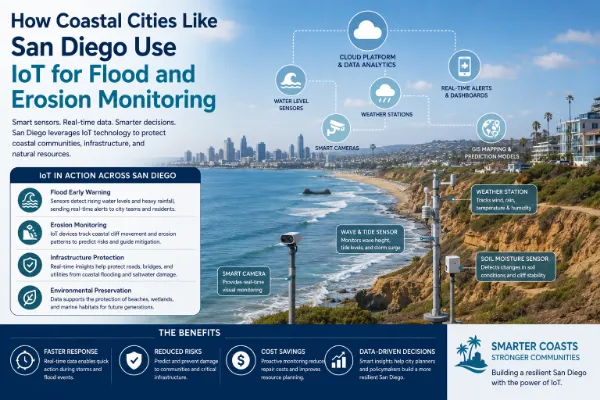
San Diego's coastal geography creates a specific application for urban IoT that many inland cities don't need to prioritize: continuous monitoring of coastal erosion, sea level rise indicators, and flood risk along the county's extensive shoreline. Connected sensor networks tracking these conditions feed directly into digital twin models used by coastal planning agencies, supporting decisions about infrastructure resilience investment in a way that periodic manual surveys never could match for timeliness.
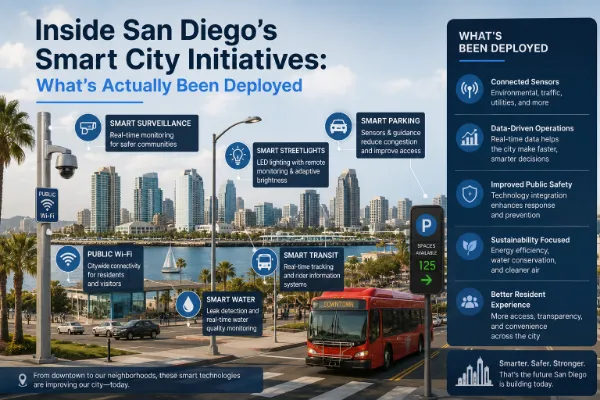
Beyond the higher-profile streetlight and digital twin programs, San Diego has continued expanding lower-profile environmental sensing, air quality monitoring, structural health sensors on aging infrastructure, and smart waste management systems that route collection based on actual fill levels rather than fixed schedules, all following the same governance-first approach established after the streetlights controversy.
- Traffic efficiency and emergency response. Real-time traffic signal coordination continues to demonstrate measurable reductions in commute times and, more critically, faster emergency vehicle routing during active incidents.
- Infrastructure cost avoidance. Digital twin-supported predictive maintenance on aging infrastructure allows the city to address developing issues before they become costly emergency repairs, a meaningful consideration given the age of significant portions of San Diego's underlying infrastructure.
- Climate resilience planning. Continuous coastal monitoring data supports more informed, better-timed infrastructure investment decisions along San Diego's shoreline, where the cost of reactive versus proactive resilience planning differs substantially.
- Restored public trust as a civic asset. The governance framework built in response to the streetlights controversy has itself become a template that other city departments and even other municipalities reference when designing new sensor deployments, representing a less tangible but genuinely valuable outcome of San Diego's difficult early experience.
- Public data use policy precedes technology deployment. Rather than installing sensors and determining data use policy afterward, current San Diego practice establishes and publishes clear data governance rules before a system goes live.
- Privacy advisory review is built into the process, rather than treated as an optional or after-the-fact check, for any new sensor deployment with potential privacy implications.
- Pilot deployments precede citywide rollout, allowing both technical performance and public reception to be assessed on a limited scale before broader investment.
- Interagency data standards are established early, so that data from transportation, utility, and public safety sensor networks can be integrated into shared digital twin models rather than remaining siloed within individual departments.
- Ongoing public reporting on data use is maintained as a standing practice rather than a one-time disclosure at launch, reflecting the specific lesson learned from the original streetlights program's lack of sustained transparency.
Balancing capability with transparency. Some of the most operationally valuable urban IoT capabilities, particularly anything camera-based, inherently carry the greatest privacy sensitivity. San Diego's ongoing challenge is capturing genuine public safety and efficiency value from these systems without triggering the trust erosion that shut down the original program.
Funding sustainability across multiple agencies. Smart city infrastructure spans transportation, utilities, public safety, and planning departments, each with separate budget cycles and priorities, making sustained, coordinated investment in shared infrastructure like digital twins administratively more complex than a single-department technology purchase.
Legacy infrastructure integration. Much of San Diego's underlying physical infrastructure, water mains, bridges, and older buildings, predates any consideration of sensor integration, meaning digital twin accuracy depends on retrofitting monitoring capability onto infrastructure that wasn't designed for it.
Maintaining public trust over time. Governance frameworks and privacy advisory boards represent an important structural change, but sustained public trust depends on consistent follow-through over years, not just a strong initial policy framework at relaunch.
The trajectory for San Diego's smart city infrastructure points toward deeper digital twin integration across departments, connecting transportation, utility, coastal resilience, and public safety data into increasingly comprehensive models that support cross-departmental planning decisions rather than siloed, department-specific tools. Given San Diego's coastal geography and the increasing attention to climate resilience infrastructure funding at the federal level, expect continued expansion of environmental and coastal monitoring specifically, an area where the operational case is strong and the privacy sensitivity is comparatively low.
For a city that experienced one of the more visible public backlashes against poorly governed urban sensor technology, San Diego's current trajectory reflects a genuinely different approach: treating public trust as infrastructure that has to be built and maintained just as deliberately as the physical sensor networks themselves.
For related coverage, see our overview of San Diego's currently deployed smart city initiatives, our detailed history of the smart streetlights and traffic sensor program, and our coverage of coastal flood and erosion monitoring IoT along San Diego's shoreline. Explore more coverage in our Smart Cities category or the San Diego smart cities hub.
Frequently asked questions
The city installed approximately 3,200 sensor-equipped streetlights beginning in 2016, capable of monitoring traffic, parking, and environmental conditions. The program became controversial after it became public that footage from the embedded cameras was being accessed by police for investigations, a use case that hadn't been clearly communicated to the public when the program launched. Facing significant backlash, the city shut the program down in 2020.
Yes, the program was relaunched under a revised governance framework that includes a dedicated privacy advisory board and clearer, publicly documented policies about permitted data use, developed specifically in response to the issues that led to the original shutdown.
A digital twin is a continuously updated virtual model of physical infrastructure, fed by real-time sensor data, that allows planners and engineers to simulate scenarios and identify problems before committing to costly physical interventions. San Diego uses this approach for infrastructure planning across water systems, bridges, and coastal resilience projects.
San Diego's current approach emphasizes establishing public data use policy and privacy advisory review before a new sensor system is deployed, rather than developing governance reactively after concerns arise. This sequencing was a direct response to the trust breakdown experienced with the original streetlights program.
San Diego's extensive coastline and exposure to erosion and sea level rise create planning challenges that periodic manual surveys can't address with sufficient timeliness. Continuous sensor monitoring feeding into digital twin models allows coastal planning agencies to make more informed, better-timed infrastructure resilience decisions.
The privacy advisory board structure established after the streetlights controversy is intended to provide a formal channel for public and expert input on new sensor deployments with privacy implications, though the specific process and level of public involvement varies depending on the department and project.
Related articles

 Smart Cities