San Diego does not need another definition of a smart city. It already has connected transportation systems, energy infrastructure, water technology, public-safety systems, building data and environmental monitoring.
The harder 2026 question is whether those systems can work together when a city problem crosses departmental boundaries.
A wildfire does not belong only to the fire department. It affects utilities, transportation, communications and emergency management. A flooded roadway is simultaneously a drainage, transportation and public-safety problem. An EV charging hub can affect transportation, building loads and the electrical grid.
This is why the next phase of San Diego's smart-city development should be understood as an interoperability challenge rather than a sensor-deployment race.
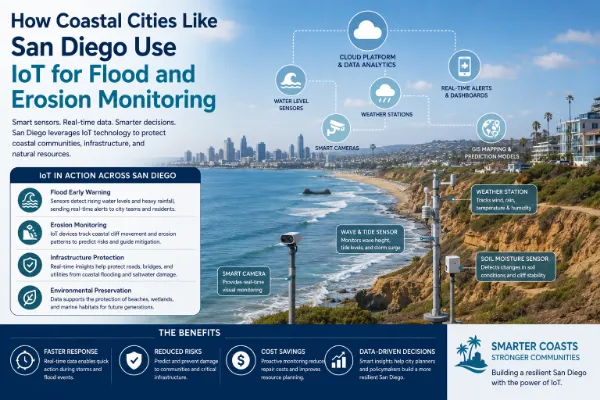
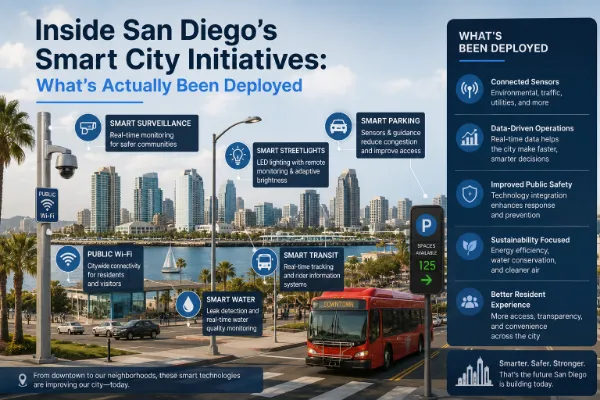
The region has years of experience with connected infrastructure. Our previous article on San Diego smart-city initiatives already deployed in 2026 covers the breadth of existing projects.
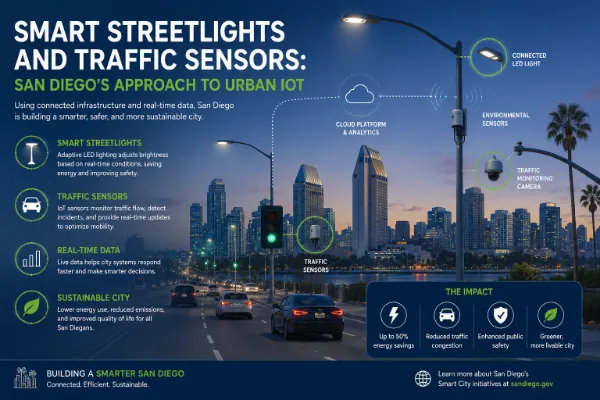
Our coverage of smart streetlights and traffic sensors also shows why one highly visible technology should not define the entire smart-city strategy.
The useful question now is what happens when information from one system could improve a decision in another.
| Layer | Question | Example |
|---|
| Technical | Can systems exchange data? | APIs and common formats |
| Semantic | Do systems interpret data the same way? | Shared asset and location definitions |
| Operational | Will another department act on it? | Alert routed into an established workflow |
A project can solve the technical layer and still fail. An API that nobody uses is not operational interoperability.
Many city systems describe physical events: a water leak, collision, equipment fault, flooded intersection or power problem. Location provides a natural way to connect them.
But location data can be inconsistent. One system uses street addresses, another coordinates, another asset IDs and another intersection names.
A mature smart-city architecture needs reliable geospatial references so information from different systems can be related without manual interpretation.
Our article on digital twins, smart streetlights and San Diego urban IoT explores city-scale digital representations.
The risk is building a visually impressive city model that remains disconnected from the systems employees actually use.
A useful municipal digital twin should answer operational questions. Which assets are affected by an incident? Which work orders are open nearby? What sensor is producing an abnormal reading? Which infrastructure depends on the affected service?
The 3D visualization is optional. The relationship between assets and data is essential.
San Diego's wildfire environment provides a clear interoperability case.
Environmental sensors can identify changing weather conditions. Utilities monitor electrical infrastructure. transportation agencies manage roads. Emergency responders need situational information. Public communications systems distribute warnings.
Our wildfire IoT and emergency-response coverage demonstrates why a citywide event cannot be optimized within a single technology silo.
Smart meters and leak-detection sensors are primarily utility tools, but water events can affect streets, buildings and emergency response.
A major leak near a roadway can become a transportation issue. Abnormal water use at a municipal building can become a facility-management issue. Drought and water availability influence environmental planning.
Readers can explore the San Diego Smart Utilities hub for the utility layer.
Transportation technology increasingly crosses city boundaries. Border-management systems, smart intersections and connected-vehicle infrastructure in South Bay illustrate how mobility data operates at a regional scale.
That means smart-city architecture cannot assume every useful dataset is owned by the City of San Diego. Regional agencies, utilities, state departments and private operators can all control relevant infrastructure.
Interoperability therefore requires agreements as well as APIs.
Combining datasets can create information that is more sensitive than either source alone.
A smart-city data platform should not become an unrestricted warehouse simply because integration is technically convenient. Data minimization, purpose limitations, access controls and retention rules should follow information when it moves between systems.
This is especially important for public-safety and mobility data.
One tempting strategy is copying every city dataset into one central platform. That can simplify some analytics but creates governance, synchronization and security challenges.
In many cases, federated access is more appropriate. Systems remain authoritative for their own data while exposing selected information through documented interfaces.
The architecture should be chosen according to the operational need rather than a preference for centralization.
- What existing city system already knows something relevant?
- Which department or organization will act on the output?
- How will assets and locations be identified consistently?
- What information genuinely needs to be shared?
- How will the integration be maintained after the pilot ends?
Smart-city fragmentation often begins with procurement. Each project can acquire a platform optimized for one department, leaving integration for later.
Contracts should address data ownership, export capability, APIs, documentation and what happens if the city changes vendors.
A low-cost sensor network can become expensive if its data cannot be used outside the vendor's dashboard.
As more analysis occurs on cameras, gateways and roadside equipment, not every raw dataset will need to travel to a central platform.
This can improve response time and reduce bandwidth, but city architects need consistent ways to manage edge devices, models and software updates.
San Diego-based technology development is contributing to this trend. Our Qualcomm profile provides local context around edge computing and connected-device technology.
A smart-city project should not be judged by the number of sensors installed.
Useful metrics depend on the problem: incident response time, water loss, traffic delay, energy use, maintenance cost or service reliability. When multiple systems contribute, the city should measure the end-to-end outcome rather than each technology in isolation.
San Diego's connected infrastructure is becoming too broad to manage as a collection of independent technology projects.
The next stage requires common asset definitions, documented interfaces, cybersecurity standards, data-governance rules and workflows that cross organizational boundaries.
That work is less visible than installing a new sensor. It is also more durable.
A smart city should not be defined by how much data it collects. It should be defined by how effectively authorized people and systems can use the right information to operate infrastructure and deliver services.
San Diego already has many of the connected pieces. The competitive advantage now lies in making those pieces function as a system without erasing the operational and privacy boundaries that exist for good reasons.
Frequently asked questions
It is the ability of city technologies and organizations to exchange, interpret and operationally use information across different systems.
Systems also need common meanings for assets and locations, appropriate governance and workflows that ensure useful information reaches someone able to act on it.
Not always. Some use cases benefit from centralization, while others are better served by federated access to authoritative systems.
They can connect assets, locations, sensor data and operational records so staff can understand how infrastructure relates to an event or problem.
Important requirements include data ownership clarity, export capability, documented interfaces, security, lifecycle support and a practical path to integrate with other systems.
Measures should focus on service and infrastructure outcomes such as response time, reliability, water loss, energy use, traffic delay or maintenance efficiency rather than sensor counts.
Related articles

 Smart Cities