Few smart city stories illustrate the gap between "deploy the sensors" and "earn the public's trust to actually use them" as clearly as San Diego's smart streetlight program. It's a case study that other cities have studied closely not because the technology was unusual, but because the sequence of events, from ambitious rollout to shutdown to a much narrower relaunch, has become something of a template for how urban IoT programs recover after a trust failure.
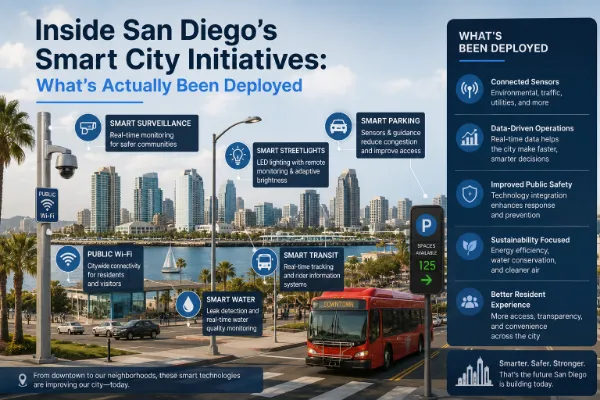
San Diego's original smart streetlight initiative began in 2016, framed primarily as a cost-saving LED retrofit project. But the sensor package that came along with the LED upgrade was far more ambitious than lighting efficiency alone. Built on GE's CityIQ platform, each of the roughly 3,200 installed units packed in an onboard computer, two 1080p video cameras, acoustic sensors, and environmental sensors tracking temperature, humidity, pressure, and vibration with much of the processing happening on-device before selected data streamed to the cloud.
The stated ambitions extended well beyond public safety: identifying open parking spaces for drivers, flagging the most dangerous intersections based on near-miss patterns rather than just recorded collisions, and opening the data to outside software developers through public hackathons. It was, in effect, a general-purpose urban sensing platform that happened to be mounted on streetlights.
That breadth became the program's undoing. Concerns accumulated over several years about data transparency, how San Diego Police were accessing and using footage, and the lack of clear public oversight over a system that had quietly grown into one of the largest urban camera networks in the country. In September 2020, then-Mayor Kevin Faulconer ordered the sensors deactivated pending the creation of actual governance rules rules that didn't yet exist despite the program having been running for roughly four years.
The three-plus years the streetlights sat dark weren't wasted time from a policy standpoint. The city used that period to pass a Surveillance Ordinance requiring community engagement, privacy review, and City Council approval for any new or existing surveillance technology, and to stand up a Privacy Advisory Board specifically to vet these kinds of proposals before deployment. That governance structure imperfect and still contested by privacy advocates is arguably the more consequential legacy of the original program's failure than the technology itself.
When the streetlight cameras came back, they came back narrower and under a materially different framework: 500 locations rather than 3,200, paired specifically with Flock Safety's Automated License Plate Recognition system rather than the broad CityIQ sensor suite, and governed by a published Surveillance Use Policy limiting review to felony investigations, critical public threats, or locating at-risk missing people. Video is overwritten after 15 days and ALPR data after 30 days unless it becomes evidence in an active case, and the city publishes a searchable map of camera locations along with a Flock-run transparency portal showing ALPR system activity.
The current system pairs two distinct pieces of technology at each of the 500 locations:
- Situational cameras mounted on existing LED streetlight infrastructure, providing video coverage of the surrounding area with privacy screening intended to avoid capturing footage inside private property.
- Automated License Plate Recognition cameras, run through Flock Safety's platform, that scan and log vehicle plates against watch lists including stolen vehicle reports and vehicles connected to active investigations and generate real-time alerts when a flagged plate is detected.
Deployment wasn't entirely smooth. During installation, SDPD found that more than 40 of the originally proposed 500 locations had infrastructure problems insufficient electrical capacity, obstructed camera lines of sight from buildings or trees, or poles that had been removed since the sites were selected which pushed the department to request more flexibility to relocate planned sites as issues surfaced. By its first full year of operation, SDPD reported the combined system had contributed to hundreds of criminal investigations, including dozens of stolen vehicle recoveries, and the city's Public Safety Committee reauthorized continued use of the technology at the end of 2025.
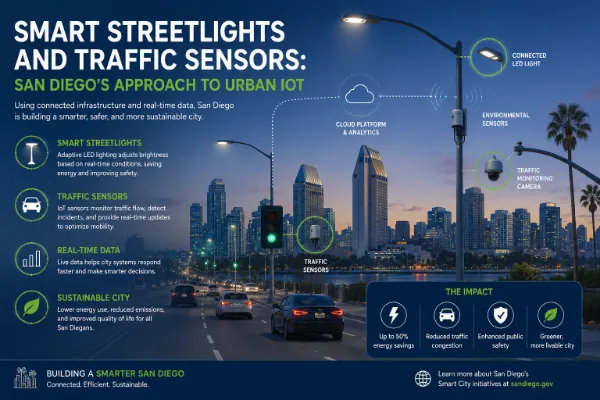
Compared to the streetlight saga, San Diego's traffic sensor deployment has generated far less public controversy partly because it's less visible, and partly because it doesn't carry the same surveillance implications. The city operates more than 1,600 signalized intersections, the large majority still running on fixed-schedule or basic traffic-responsive control logic rather than genuinely adaptive, sensor-driven timing.
The most significant push toward real adaptive control is happening around UC San Diego's La Jolla campus, where a university-funded, roughly $5 million project is installing sensor-based adaptive signals at 26 intersections along Regents Road, La Jolla Village Drive, and North Torrey Pines Road. Unlike the fixed-schedule signals common across most of the city, these systems use real-time traffic sensors and inter-signal communication to adjust green-light timing dynamically extending or shortening a green phase based on actual traffic present rather than a preset schedule with the explicit goal of reducing the idling time that contributes to both congestion and vehicle emissions along that corridor.
Underneath any future expansion of that kind of system is less glamorous infrastructure work: citywide traffic signal communication upgrades connecting individual intersection controllers back to centralized monitoring over wireless radio links, a project underway in coordination with neighboring jurisdictions like Escondido. This is the unglamorous backbone work that has to happen before adaptive, AI-driven signal timing can scale beyond a single university-adjacent corridor to the rest of the city's 1,600-plus intersections.
San Diego's experience offers a fairly clear takeaway for any city or vendor thinking about deploying urban IoT at scale: the technical capability to collect broad, general-purpose sensor data is not the same as having a mandate to do so. The original CityIQ deployment wasn't shut down because the sensors malfunctioned it was shut down because the governance, transparency, and public trust infrastructure hadn't been built before the technology went live. The version that came back is narrower in scope but has survived multiple years of operation and reauthorization, in large part because the policy framework was built first, deliberately, with public input, rather than retrofitted after deployment.
For vendors selling urban IoT and public safety technology, San Diego's experience has become something of a reference case in how to and how not to sequence a rollout. Ubicquia and Flock Safety, the two vendors behind the current program, both benefited from a City Council and Privacy Advisory Board process that forced a clearly documented, publicly available Surveillance Use Policy before a single camera went live in its current form a stark contrast to the original 2016 program, which expanded its data collection ambitions gradually and informally without a comparable policy document ever being finalized. Vendors pitching similar technology to other cities now routinely point to San Diego's governance framework, and to Flock's public transparency portal specifically, as evidence of the kind of accountability structure a city council or privacy board is likely to expect before approval.
Frequently asked questions
They were deactivated in September 2020 due to concerns about data transparency and how police were accessing footage, in the absence of any formal governance policy the ordinance and privacy oversight board governing the technology didn't yet exist when the program launched in 2016.
It's smaller (500 locations versus roughly 3,200), narrower in scope (paired specifically with license plate recognition rather than the broader CityIQ sensor suite that included parking and environmental data), and operates under a published Surveillance Use Policy with defined data retention limits and public transparency requirements.
Not yet at scale. The most advanced adaptive signal deployment is a UC San Diego-funded project covering 26 intersections near the La Jolla campus. Most of the city's 1,600-plus signalized intersections still run on more basic, largely fixed-schedule control.
Video is overwritten after 15 days and ALPR data after 30 days, unless it's retained as evidence in an active investigation, under SDPD's published Surveillance Use Policy.
Yes. SDPD maintains a public, searchable map of installed Smart Streetlight and ALPR locations, along with a separate transparency portal covering ALPR system activity, in compliance with the city's surveillance ordinance.
SDPD found infrastructure issues at more than 40 of the originally selected sites insufficient electrical capacity, obstructed sightlines, or removed poles which required requesting additional flexibility to relocate planned camera locations during rollout.
Related articles

 Smart Cities