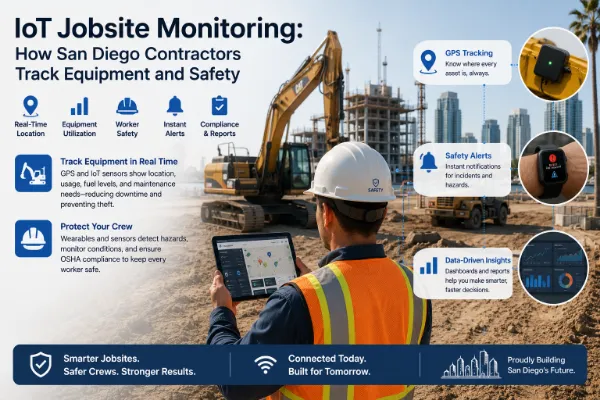
California accounts for roughly 20% of all construction equipment theft in the United States the highest rate in the nation and San Diego's active 2026 construction pipeline, with major infrastructure work reshaping Chula Vista and Oceanside, has made local jobsites an increasingly attractive target. A single theft incident can cost $30,000 to $50,000 once equipment loss and project delays are factored in, and insurance providers have taken notice: many now require verified active monitoring on large-scale projects just to maintain coverage or qualify for premium reductions. That combination of real financial exposure and tightening insurance requirements is what's actually driving IoT jobsite monitoring adoption among San Diego contractors in 2026, more than any abstract enthusiasm for new technology.
The residential-grade camera kit that works fine for a driveway doesn't hold up on a commercial jobsite. Consumer equipment isn't built for the rugged, dusty, and often unpowered conditions typical of a San Diego canyon grading project or a coastal build, and it tends to fail under environmental stress at exactly the moments it matters most creating what local security specialists call a false sense of security rather than actual protection.
What's replaced it across the region's more active jobsites is the solar-powered mobile trailer: self-contained units combining cameras, connectivity, and battery storage that can deploy in under 24 hours regardless of whether a site has grid power. These units maintain uptime through cloud cover without relying on a permanent electrical connection, which matters on a project that might only occupy a given site for a few months before the crew moves on. Paired with AI-driven video analytics that filter out false alarms from wind-blown debris or wildlife filtering out more than 90% of non-threat triggers on well-tuned systems the result is that a remote monitoring team can focus attention specifically on verified human threats rather than reviewing hours of irrelevant footage after the fact.
Beyond perimeter security, GPS-based telematics on heavy machinery excavators, dozers, lifts, generators has become close to standard on larger San Diego projects, and it delivers value well beyond theft recovery. Telematics platforms report engine fault codes and run-time data that flag developing mechanical issues before they become an expensive breakdown, turning maintenance from a reactive scramble into a scheduled event. They also capture idle time, fuel consumption, and overuse patterns, which surface waste that's otherwise invisible on a busy site and directly protects both uptime and the asset's resale value over its working life.
The scale of this data at the industry level is worth noting: leading telematics platforms now process trillions of data points across millions of connected pieces of equipment, and newer tools let fleet managers query that data in plain language rather than digging through a dashboard a meaningful shift for the small and mid-size contractors that make up most of San Diego's construction sector, who don't have a dedicated data analyst on staff to build custom reports.
Construction remains one of the highest-risk industries in the country, and OSHA doesn't just expect a safe site it expects accurate, time-stamped, location-stamped records proving safety protocols were followed, which a manual sign-in sheet or a supervisor's memory simply can't provide under scrutiny. This is where jobsite wearables have moved from novelty to practical necessity:
- Location-aware hard hat sensors and vests track worker position across a site in real time, supporting both day-to-day operational visibility and, critically, emergency muster accounting when an alarm sounds, a supervisor gets a live, accurate roster instead of a clipboard and a guess.
- Fall detection and no-motion alerts matter especially for the isolated work that construction routinely involves a single worker finishing a punch list in a basement or on a roof after the main crew has left, where traditional GPS often goes completely blind inside concrete structures or below grade, precisely where fall and confined-space risks are highest.
- Environmental sensors built into helmets track ambient temperature and alert workers directly when conditions hit dangerous thresholds genuinely relevant given how many San Diego County jobsites, particularly inland toward El Cajon and Escondido, regularly see extreme summer heat.
- Geofencing creates virtual boundaries around hazardous zones or active equipment operating radii, triggering automated alerts if a worker or unauthorized vehicle crosses into a restricted area reducing both accident risk and unauthorized site access in one system.
Pricing for this category has come down enough to matter for mid-size contractors specifically: basic sensor-equipped hard hats start around $150, while full AR-enabled units with more advanced hazard detection run $2,000 or more, giving contractors room to scale wearable investment to project size and risk profile rather than requiring an all-or-nothing commitment.
One practical wrinkle that shows up more in San Diego than in flatter markets is terrain-driven connectivity. Canyon sites, hillside grading projects, and backcountry infrastructure work common across the county's topography can create real cellular dead zones that undermine a monitoring system built solely around a standard LTE connection. Contractors working these sites increasingly specify equipment with cellular failover paired with local mesh networking between devices, so a hard hat sensor or equipment tracker can still relay data through a nearby gateway even when its own direct connection to the cellular network is weak or intermittent. This is a detail worth raising explicitly with any vendor during procurement, since a system that performs flawlessly on a flat urban infill lot can perform noticeably worse on a hillside site in East County without that added resilience built in.
Beyond the immediate safety and security case, the data these systems generate increasingly flows into broader project management. Automated time and attendance from geofenced check-ins eliminates buddy-punching and manual time cards, feeding directly into labor cost tracking without added administrative work. Incident documentation with precise time and location data speeds up workers' compensation claims and reduces disputed liability investigations. And the evacuation logs generated by wearable and geofencing systems during drills or real events provide auditable proof to insurers and regulators that safety protocols were actually followed, not just documented after the fact.
For contractors weighing whether this investment is worth it, the clearest framing is usually insurance-adjacent rather than purely operational: a single avoided theft or a single avoided serious injury claim routinely covers a full season's worth of monitoring costs on its own. That framing tends to land better with ownership than a general efficiency pitch, particularly for mid-size San Diego contractors juggling tight margins on competitively bid projects. It's also worth pairing any new deployment with an honest look at what happened on past projects a contractor who can point to a specific prior theft loss or a specific near-miss safety incident has a much easier time justifying the recurring subscription cost of a monitoring platform than one making a purely hypothetical case.
A few practical cautions are worth flagging for San Diego contractors evaluating this technology for the first time. Worker privacy concerns around continuous location tracking are real and worth addressing directly with crews before rollout, rather than treating it as a footnote adoption goes more smoothly when workers understand the safety rationale rather than experiencing it as unexplained surveillance. Battery management across dozens or hundreds of wearable devices is a genuine ongoing logistical task, not a one-time setup detail. And environmental toughness matters more for San Diego's varied terrain than it might elsewhere a device that works fine on a flat urban infill site may need a more rugged rating for a canyon grading project or an exposed coastal build.
Frequently asked questions
California accounts for roughly 20% of all construction equipment theft nationally, the highest rate in the country, and San Diego's active 2026 construction pipeline has made local jobsites increasingly attractive targets for organized theft operations.
Many insurance providers have shifted their 2026 requirements to mandate verified active monitoring for large-scale projects as a condition of maintaining coverage or qualifying for premium reductions, making this less optional than it was a few years ago.
Basic sensor-equipped hard hats start around $150, while full AR-enabled units with advanced hazard detection can run $2,000 or more, allowing contractors to scale investment based on project size and risk level.
Traditional GPS signals are blocked by concrete and underground structures, which is exactly where fall and confined-space risks are highest. Many modern systems address this using mesh networks or BLE-based tracking that doesn't depend on a clear satellite signal.
Yes. Automated, time-stamped and location-stamped records from wearables and access systems create the kind of auditable evidence OSHA inspections expect, which manual sign-in sheets and memory-based reporting can't reliably provide.
No. Solar-powered mobile security trailers and basic wearable devices have both become accessible enough in cost and deployment complexity that mid-size and smaller San Diego contractors are adopting them, not just large national builders.
Related articles

 Construction & Real Estate