San Diego multifamily owners have historically adopted smart home technology as a leasing amenity the kind of feature that shows well on a listing and helps a unit rent a little faster. That's still true in 2026, but it's no longer the main story. A wave of new California and San Diego-specific landlord requirements taking effect this year has quietly turned several categories of IoT technology from a nice-to-have into something closer to risk management, and multifamily owners who understand that shift are getting more out of their technology investment than those still thinking of it purely as a tenant perk.
A few 2026 changes are worth understanding specifically because of how directly they connect to IoT tools already on the market. Starting January 1, 2026, California requires a working stove and refrigerator in every unit covered by a new or renewed lease under amended Civil Code Section 1941.1 a unit without functioning appliances is now legally uninhabitable, and if an appliance is recalled, landlords have just 30 days to repair or replace it. Separately, California's mandatory balcony inspection law requires buildings with three or more units and elevated exterior elements more than six feet above grade to complete structural inspections by a licensed professional on a recurring schedule one of the most commonly missed compliance requirements for multifamily owners in the region. On top of both, San Diego's own Tenant Protection Ordinance requires just-cause justification for eviction from day one of a tenancy, and rent increases are capped at 5% plus CPI, adding financial pressure that makes avoiding costly, preventable damage claims more important than ever.
None of these rules mandate IoT technology directly. But each one creates a specific, high-consequence failure mode a broken appliance nobody caught in time, a balcony structural issue missed between inspection cycles, a maintenance dispute that escalates into a habitability claim that IoT monitoring is well suited to catch earlier and document more thoroughly than a periodic manual walkthrough ever could.
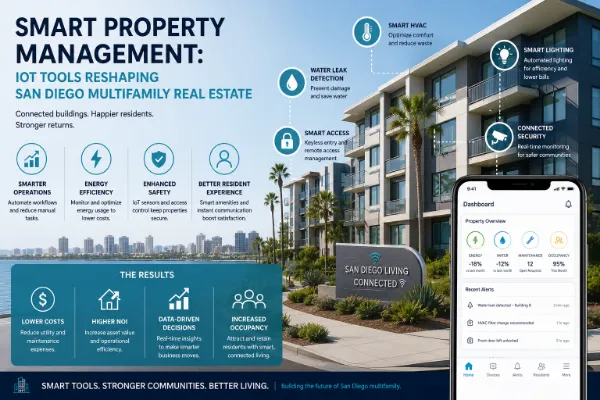
Water damage remains one of the most expensive and disruptive things that can happen to a multifamily building, and it's also one of the more preventable ones with continuous monitoring. Wireless leak sensors placed near water heaters, under sinks, and near washing machine connections can shut off supply valves automatically or alert on-site staff the moment a leak starts, rather than the more common scenario of a slow leak going undetected for days until it's damaged flooring, drywall, and potentially a unit below. Given San Diego's aging multifamily housing stock, particularly in neighborhoods with a large share of buildings from the 1960s through 1980s, this category alone tends to deliver the most straightforward payback of any smart property investment avoided water damage claims routinely dwarf the sensor cost many times over.
IoT-enabled submetering lets owners bill tenants based on actual water and energy usage rather than a flat allocation by square footage, which both improves fairness and creates a natural incentive for tenants to reduce waste. Smart thermostats and building-wide energy management systems that automatically adjust based on occupancy and weather conditions reduce common-area utility costs directly, an increasingly material line item as SDG&E's commercial and residential rates continue climbing. For owners managing a portfolio across multiple San Diego properties, centralized dashboards that aggregate usage data across the whole portfolio also make it far easier to spot an anomaly a unit using dramatically more water than comparable units, for instance that might otherwise indicate an undetected leak or a metering error.
Smart locks and centralized access control systems have become standard enough in new San Diego multifamily construction that their absence is increasingly a competitive disadvantage in a tight rental market. Beyond the tenant convenience of keyless entry, these systems generate an audit trail of who accessed common areas and when genuinely useful for both security incident investigation and, less obviously, for demonstrating a landlord's diligence around building safety if a dispute or liability claim arises later. Video-enabled entry systems and package management lockers round out the amenity side of this category, addressing what remains one of the most common tenant complaints in dense, multi-unit buildings.
Given the state's new mandatory balcony inspection requirement, a smaller but growing set of San Diego multifamily owners are exploring continuous structural sensors moisture and load monitoring on elevated exterior elements as a way to supplement, not replace, the required licensed professional inspections. Continuous monitoring can't substitute for a certified inspection under the law, but it can provide earlier warning of developing issues like water intrusion into a balcony structure between scheduled inspection cycles, which is exactly the kind of gap that has historically led to the deferred-maintenance failures the new law is meant to prevent. This is a newer application of IoT in the multifamily space compared to leak detection or access control, and adoption is still limited, but it's a logical extension of the same "catch it before it's a habitability crisis" logic driving the rest of this shift.
Smart property technology scales reasonably well with portfolio size. A single leak sensor runs in the range of $30 to $80 depending on the model and connectivity type, making building-wide coverage for even a modest apartment complex a relatively small capital outlay compared to the cost of a single significant water damage claim. Smart locks and access control systems represent a larger per-door investment, but increasingly get bundled into renovation or tenant-turnover budgets rather than requiring a separate capital project. The more meaningful ongoing cost for most owners isn't hardware it's the property management platform subscription that aggregates data across sensors, submeters, and access systems into a usable dashboard, which is where most of the actual operational value gets realized.
A less-discussed but increasingly relevant angle for San Diego multifamily owners is how insurers are starting to treat this technology. As water damage claims remain one of the most common and expensive categories of multifamily property loss, some insurance carriers now offer meaningful premium credits for buildings with verified continuous leak detection coverage, treating it similarly to how a monitored fire alarm system has long been treated in commercial underwriting. It's worth asking a current insurance broker directly whether a specific carrier offers this kind of credit before assuming the cost of a leak sensor rollout falls entirely on the maintenance and damage-avoidance side of the ledger in some cases, the insurance savings alone cover a meaningful share of the ongoing platform cost.
San Diego owners evaluating smart property platforms should pay particular attention to a few practical factors beyond the headline feature list. Integration with existing property management software matters more than any individual sensor's capability, since a leak sensor or smart lock that can't feed into the same dashboard as maintenance ticketing and accounting quickly becomes another disconnected system rather than a genuine efficiency gain. Data ownership and portability are also worth confirming upfront owners should understand what happens to historical sensor and access data if they switch property management companies or platforms down the line, since that continuity matters both operationally and, increasingly, as documentation supporting compliance with the habitability and inspection requirements discussed above.
The trajectory for San Diego multifamily IoT adoption is toward tighter integration between these previously separate systems leak detection, submetering, access control, and maintenance ticketing increasingly living in a single platform rather than requiring property managers to check multiple dashboards. As California's regulatory environment for landlords continues adding new documentation and habitability requirements, the practical case for continuous, automatically logged monitoring rather than periodic manual inspection alone is only going to get stronger, particularly for owners managing larger portfolios where the cost of a single missed issue scales with the number of doors.
Frequently asked questions
Not directly, but smart leak and appliance monitoring can help owners catch a failing stove or refrigerator before it becomes a habitability violation under the new requirement, which took effect January 1, 2026.
No. California's balcony inspection law requires a licensed professional to complete inspections on a set schedule. Continuous structural sensors can supplement that requirement by flagging developing issues between inspection cycles, but they don't satisfy the legal requirement on their own.
Wireless leak detection tends to have the clearest and quickest return, since a single avoided water damage claim typically far exceeds the cost of building-wide sensor coverage.
Submetering doesn't affect rent caps directly, but it does let owners bill for actual utility usage separately from rent, which can help offset rising utility costs without running into the rent increase limits under the Tenant Protection Ordinance.
No. Most smart leak, submetering, and access control systems are designed for retrofit into existing buildings and are commonly added during renovation or tenant turnover rather than requiring new construction.
Centralized access systems generate a time-stamped log of who entered common areas and when, which can help demonstrate a landlord's diligence around building security if a dispute or liability claim arises later.
Related articles

 Construction & Real Estate