San Diego needs roughly 108,000 new housing units by 2029 to meet state-mandated targets, according to the region's most recent Regional Housing Needs Assessment cycle, and the county is nowhere close to that pace. Every month a project sits delayed by a permitting bottleneck, a materials shortage, or a jobsite safety incident is a month of housing that doesn't get built. That pressure is why a growing number of San Diego general contractors and developers are moving past static building information modeling and adopting connected jobsite sensors and live digital twins, tools that turn a construction site into a continuously monitored system rather than a project managed off spreadsheets and site walks.
This isn't about chasing the latest proptech trend. It's a direct response to a labor-constrained, cost-pressured local market where every week of schedule slippage has a real dollar figure attached to it.
Construction in San Diego carries some of the highest per-unit costs in the country, driven by land scarcity, labor costs, and a permitting process that developers frequently describe as one of the slower ones in Southern California. In that environment, the margin for error on schedule and rework is thin. A single undetected moisture intrusion issue, a missed inspection window, or an equipment theft incident can push a multifamily project's completion date by weeks, and weeks translate directly into carrying costs on land and construction loans that are already expensive in this market.
Connected sensors and digital twins address this by replacing periodic, manual checks, a superintendent walking the site once a day, a subcontractor self-reporting progress, with continuous, automated visibility. For projects competing against tight financing timelines, that shift from periodic to continuous monitoring is often the difference between hitting a delivery date and missing it.
The technology stack breaks down into a few distinct layers, and most contractors don't adopt all of them at once.
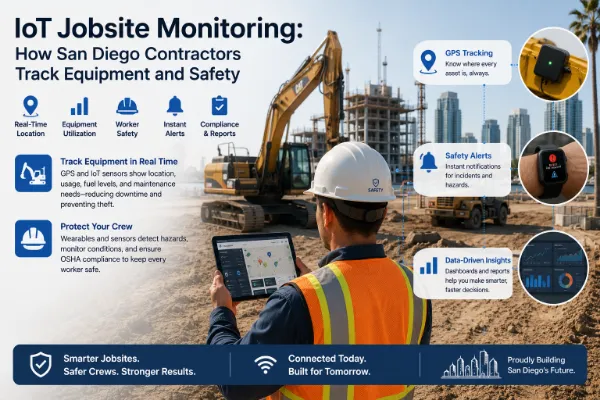
GPS and Bluetooth-based tags on generators, compressors, and specialty tools address one of the most persistent cost drains on infill and multifamily sites in denser San Diego neighborhoods: equipment theft and unauthorized use. Tracked equipment also feeds utilization data back to project managers, who often discover they're renting more equipment than the site actually needs.
Wireless sensors tracking concrete cure temperature, humidity in framing before drywall goes up, and vibration during excavation near existing structures, a common concern in San Diego's older, densely built neighborhoods like North Park and South Park, catch problems that would otherwise surface as expensive rework months later.
Connected hard hats and wearable devices that monitor heat stress are increasingly relevant given San Diego's inland construction sites, where East County temperatures regularly exceed coastal readings by 15 to 20 degrees during summer months. These devices also support proximity detection around heavy equipment, addressing one of the leading causes of jobsite injury.
For developers running several projects simultaneously across the county, a live digital twin, a continuously updated 3D model synced with sensor data, lets a project executive compare actual progress against the BIM model without visiting every site in person. This matters more in San Diego than in a single-city market because active projects are frequently spread from Chula Vista to Oceanside, and windshield time between sites is real overhead.
Contractors and developers evaluating this technology should think about the return on investment in four categories:
- Reduced rework. Catching moisture or structural issues during construction rather than after drywall or finishes are installed is dramatically cheaper. Industry data consistently shows rework costs multiply the later a defect is discovered in the build sequence.
- Lower insurance and liability exposure. Insurers are increasingly offering premium reductions for jobsites with documented safety monitoring, and a clear sensor-based audit trail is valuable if a dispute or claim arises.
- Faster financing draws. Lenders on construction loans typically require progress verification before releasing draw payments. Digital twin documentation can shorten the time between a milestone being reached and funds being released, which matters when carrying costs are accruing daily.
- Reduced equipment loss. On San Diego's more exposed infill sites, tracked equipment consistently shows measurable reductions in theft-related losses within the first year of deployment.
Contractors who successfully adopt this technology tend to follow a similar sequence rather than instrumenting an entire project portfolio at once.
- Pilot on one active project, ideally a multifamily or mixed-use build where the schedule risk and rework cost are highest.
- Start with equipment tracking since it has the fastest, most measurable return and requires the least workflow change for site crews.
- Add environmental monitoring at critical build phases such as concrete pours and pre-drywall inspections, rather than monitoring the entire site continuously from day one.
- Layer in wearables for safety-critical crews once the site team has adjusted to the initial sensor rollout.
- Build the digital twin last, once there's enough live sensor data flowing to make the model genuinely useful rather than a static visualization.
Contractors evaluating vendors should also scope infrastructure needs upfront. A site without reliable connectivity or with cabling that predates the sensor deployment will struggle to get reliable data, which is a common source of frustration on retrofit and infill projects.
Trade contractor buy-in. Many subcontractors, particularly smaller specialty trades common in the San Diego market, are wary of monitoring technology they perceive as surveillance. Framing the deployment around safety and efficiency, not oversight, and involving crew leads early tends to reduce resistance significantly.
Connectivity gaps on active sites. Construction sites are inherently hostile environments for wireless signal, with metal framing, concrete, and constantly changing physical layouts. Contractors who assume standard Wi-Fi will cover a multi-story build often find coverage gaps that undermine sensor reliability.
Data overload without clear ownership. A jobsite generating continuous sensor data needs someone whose job includes reviewing and acting on it. Sites that deploy sensors without assigning that responsibility often end up with dashboards nobody checks.
Integration with existing project management software. Contractors already using established project management platforms need sensor data to flow into those systems rather than living in a separate, disconnected app, or adoption stalls quickly.
The next stage for San Diego's construction and real estate sector centers on the extension of digital twins past project completion. Rather than treating the twin as a construction-phase tool that gets shelved at turnover, forward-looking developers are handing live, sensor-connected models to property management teams, creating a continuous thread from groundbreaking through building operations. This is particularly relevant for San Diego's multifamily developers, many of whom retain long-term ownership stakes in the properties they build rather than selling at completion.
Regulatory pressure is also likely to accelerate adoption. As California and San Diego-specific building code requirements around energy performance and structural resilience continue to tighten, having a documented, sensor-verified construction record positions developers to demonstrate compliance more easily during inspections and future retrofits.
For San Diego contractors and developers, the calculation is straightforward: in a market where every week of delay has a real financial cost and every unit matters toward the region's housing targets, continuous jobsite visibility is becoming less of a competitive advantage and more of a baseline expectation.
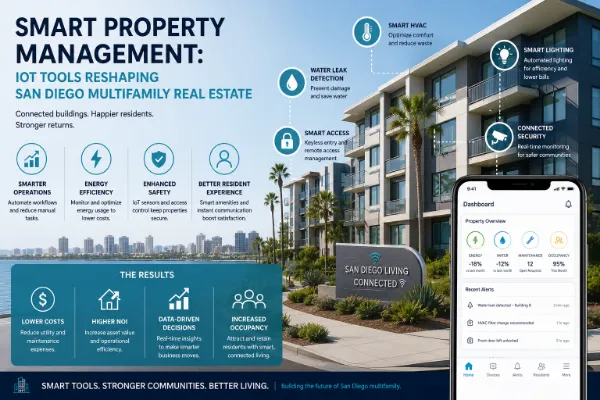
To go deeper on specific applications, see our guide to jobsite monitoring for equipment and safety, our breakdown of digital twins for San Diego developers, and our overview of smart property management IoT for multifamily owners. Developers weighing retrofit decisions after handover may also find our comparison of smart building retrofit versus new-build costs useful. Browse more coverage in our Construction & Real Estate category or the San Diego construction and real estate hub.
Frequently asked questions
BIM is a detailed 3D design model created before or during construction, largely static once finalized. A digital twin builds on that model by continuously syncing it with live sensor data from the actual jobsite, so the model reflects real-world progress, conditions, and discrepancies rather than only the original design intent.
Equipment tracking typically shows measurable returns within the first few months through reduced theft and better utilization data. Environmental and structural monitoring returns are realized more gradually, primarily through avoided rework, and become more apparent over a full project cycle.
Smaller contractors often benefit disproportionately because they have less margin to absorb rework costs or equipment losses. Starting with a low-cost equipment tracking pilot, rather than a full sensor and digital twin deployment, is a realistic entry point for smaller operations.
Well-implemented systems are designed to be passive from the crew's perspective, with sensors mounted on equipment and structures rather than requiring manual data entry. The main adjustment period involves crew comfort with monitoring, which is best addressed through clear communication about the purpose of the technology.
Vibration and structural monitoring is particularly valuable on infill sites near existing older structures, common in neighborhoods like North Park and South Park, since it provides an early warning system for settlement or vibration issues affecting adjacent properties before they become costly disputes.
A well-maintained, sensor-verified digital twin can make it easier to demonstrate compliance during inspections by providing a documented, timestamped record of construction milestones and conditions, though it does not replace the formal permitting and inspection process itself.
Related articles

 Construction & Real Estate