Retail shrinkage cost the U.S. retail industry roughly $112 billion in 2025, and organized retail crime specifically has grown by an estimated 26% year over year with average incidents involving $2,000 to $5,000 in stolen merchandise per event. San Diego County has taken this seriously enough to stand up its own dedicated response: the San Diego Organized Retail Crime Alliance (SDORCA), working in direct partnership with the County District Attorney's office, and California's Proposition 36, in effect since December 2024, restored felony penalties for repeat theft offenders after years of policy that many retailers argued had weakened deterrence. None of that changes the reality on the ground for a small or mid-size San Diego retailer, though: national chains have dedicated loss prevention departments and enterprise security budgets, and independent shops mostly don't. IoT-based tools have become one of the more practical ways to close that gap without hiring a security team.
Before investing in any technology, it's worth being honest about where shrinkage actually originates, since the answer shapes which tools are worth prioritizing. Industry-wide, external theft accounts for roughly 36% of losses, internal theft by employees another 30% to 40%, and administrative error accounts for the rest. A retailer who assumes their shrinkage is purely a shoplifting problem and invests entirely in exterior-facing security cameras may be missing a third or more of their actual loss, which requires a different kind of monitoring entirely point-of-sale exception reporting and back-office access controls, not just cameras aimed at the sales floor.
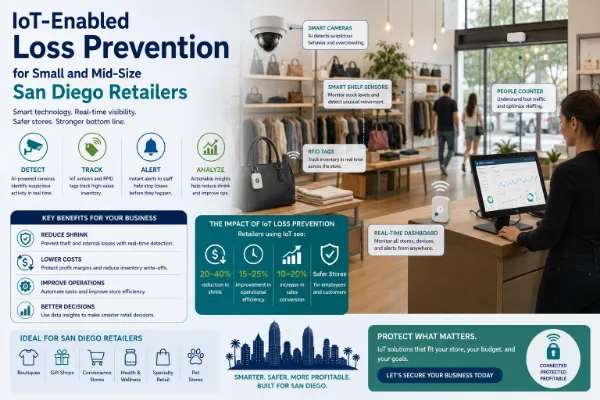
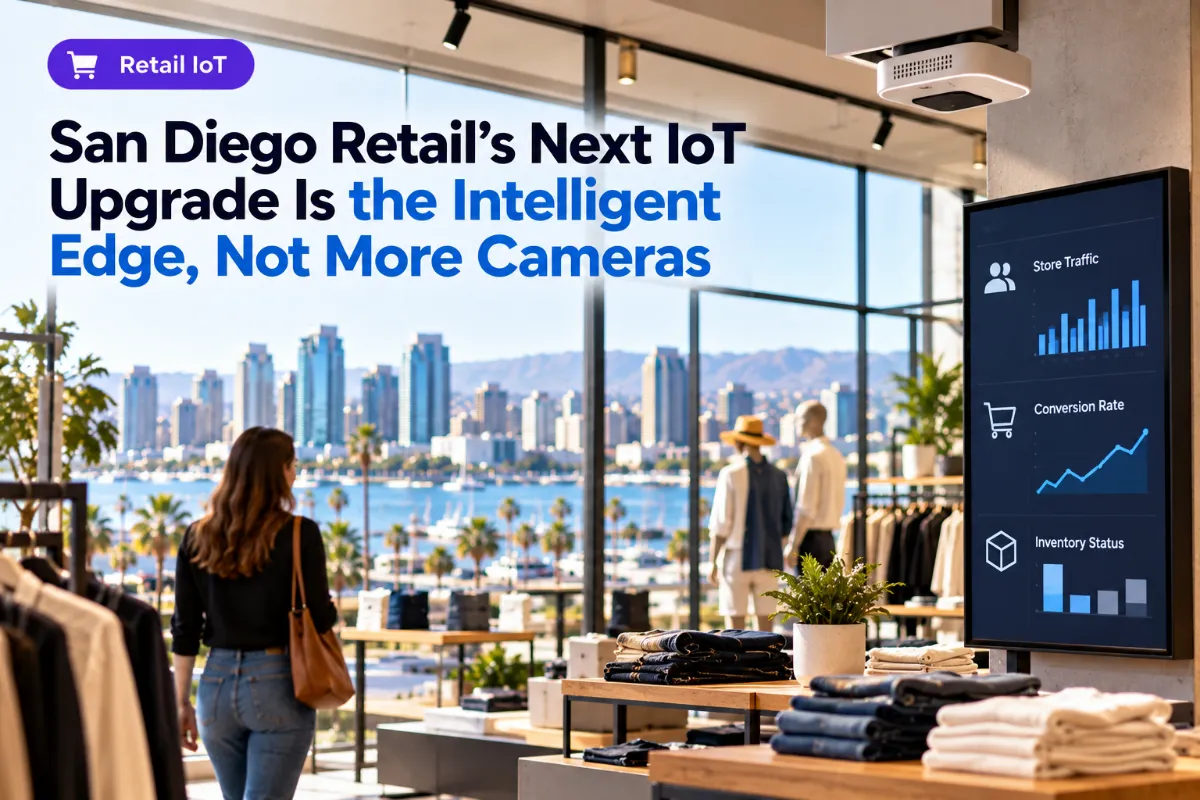
For most small and mid-size San Diego retailers, the most cost-effective entry point isn't new camera hardware at all it's AI-driven video intelligence layered on top of cameras a store likely already has installed. Modern platforms connect existing video feeds to point-of-sale data, alarm systems, and access control, allowing the software to flag specific behavioral patterns rather than requiring a human to watch hours of raw footage. The organized retail crime patterns these systems are increasingly tuned to detect include grab-and-run group theft, cart pushouts, refund and no-receipt return fraud, tag switching at self-checkout, and concealment activity in fitting rooms or using bags and strollers patterns that a single overworked employee watching a sales floor is unlikely to reliably catch in real time, especially during a coordinated, multi-person incident designed specifically to overwhelm staff attention.
RFID tagging, covered from an inventory management angle elsewhere on this site, does double duty for loss prevention specifically. A tagged item that crosses an exit sensor without a corresponding point-of-sale transaction triggers an immediate alert a meaningfully faster and less labor-intensive detection method than traditional electronic article surveillance tags alone, since RFID can also confirm exactly which item triggered the alert rather than just that something did. For San Diego retailers dealing with the high-value, easily resold categories organized retail crime rings specifically target electronics, designer goods, over-the-counter medications, and infant formula are consistently named by local loss prevention groups as favored targets RFID tagging on just those specific categories, rather than an entire store's inventory, is often the most cost-effective way to deploy this technology.
A meaningful share of shrinkage happens when a store is closed or during back-of-house operations customers never see, which makes access control and receiving-area monitoring a genuinely underused category for smaller retailers who tend to focus security spending entirely on the sales floor. IoT-connected door sensors, smart locks with logged access history, and motion-triggered alerts for stockroom and receiving areas address the "internal theft and administrative error" share of shrinkage that pure sales-floor camera coverage simply doesn't touch. Given that internal theft alone can account for a third or more of total shrinkage, this category deserves a proportional share of a smaller retailer's loss prevention budget, not an afterthought.
The gap between enterprise loss prevention platforms and what an independent retailer can realistically afford has narrowed considerably. A practical, phased approach for a smaller San Diego retailer:
- Start with AI video analytics on existing cameras. This typically requires the least new hardware investment and provides the broadest initial coverage across both external and internal loss categories.
- Add point-of-sale exception reporting. Software that flags unusual patterns excessive voids, discounts, or no-sale transactions by a specific register or employee catches internal theft and sweethearting that video alone won't reliably reveal.
- Layer in RFID for your highest-risk product categories specifically, rather than attempting store-wide tagging from the outset.
- Extend coverage to back-of-house and after-hours access, closing the gap that sales-floor-focused security typically leaves wide open.
San Diego retailers have resources available that a purely national approach to loss prevention technology wouldn't surface. SDORCA maintains information-sharing relationships between local retailers, loss prevention professionals, and the District Attorney's office specifically to help identify and disrupt organized theft patterns across the county, and participates in a window-decal deterrence program signaling active participation in the county's Retail Theft Initiative a low-cost, visible deterrent that pairs naturally with actual technology investment rather than substituting for it. The California Highway Patrol's Border Division task force, covering San Diego and Orange counties specifically, also investigates organized retail theft cases that cross store or jurisdiction lines, which is often exactly the pattern IoT-connected video and RFID systems are best positioned to help document and report.
A practical, easy-to-overlook angle for smaller San Diego retailers: many commercial insurance policies now factor documented loss prevention technology into premium calculations, similar to how monitored alarm systems have long affected coverage rates. It's worth asking a current insurance broker directly whether adding AI video analytics, RFID tagging, or access control logging to an existing policy could reduce premiums or improve claims outcomes after an incident in some cases, the insurance savings alone meaningfully offset the ongoing cost of the technology, which changes the return-on-investment math for a retailer weighing whether the upfront cost is justified purely by prevented losses.
- Over-investing in visible deterrents while under-investing in detection. Cameras and signage deter opportunistic theft, but organized retail crime crews specifically test and adapt to visible security measures, making behind-the-scenes detection and pattern recognition just as important as visible deterrence.
- Treating all shrinkage as an external theft problem. Given that internal theft and administrative error together often account for the majority of losses, a security strategy focused purely on shoplifters addresses less than half the actual problem.
- Inconsistent policy enforcement across shifts. Loss prevention specialists consistently note that theft crews test store procedures before exploiting them inconsistent fitting room policies or unclear escalation procedures between shifts create exactly the kind of predictable gap organized crews look for.
- Failing to document incidents in a way that supports prosecution. Under Proposition 36's restored felony penalties for repeat offenders, well-documented, time-stamped video and transaction evidence has real prosecutorial value it didn't have as consistently under prior policy making the documentation quality of whatever system a retailer chooses genuinely important, not just its deterrent value.
For a San Diego retailer with no existing loss prevention infrastructure and a genuinely limited budget, the practical first move is often simply an honest shrinkage audit reconciling point-of-sale records against physical inventory counts over a defined period to get a real, specific number rather than a general sense that "things go missing sometimes." That number, broken down by category and by shift where possible, does more to justify a specific technology investment internally than any industry-wide statistic, and it also helps clarify whether the bigger problem is actually external theft, internal shrinkage, or administrative error three problems that call for genuinely different first investments, as outlined above.
Frequently asked questions
External theft typically accounts for around 36% of shrinkage, internal theft by employees for 30% to 40%, and administrative errors for the rest meaning a security strategy focused only on shoplifters misses a large share of the actual problem.
The San Diego Organized Retail Crime Alliance is a partnership between local retailers, loss prevention professionals, and the County District Attorney's office focused on information sharing and coordinated response to organized retail theft across the region.
Selectively tagging only high-risk, easily resold categories electronics, designer goods, and similar items frequently targeted by organized retail crime makes RFID a cost-effective option for smaller retailers, rather than requiring store-wide tagging.
Yes. Effective since December 2024, it restored felony penalties for repeat theft offenders, which has increased the practical value of well-documented, time-stamped evidence from IoT-connected video and transaction systems in supporting prosecution.
AI-driven video analytics layered onto cameras a store already has installed is typically the lowest-hardware-cost, broadest-coverage starting point, before investing in RFID or dedicated access control systems.
Local loss prevention groups consistently report that ORC crews target stores with strong merchandise selection and comparatively thin security coverage, particularly in high-traffic commercial districts, rather than any single store type.
Related articles

 Retail IoT