Ask a San Diego retailer what's holding back their inventory technology investment, and the answer increasingly isn't cost, it's California's privacy law. The California Consumer Privacy Act, along with the state's expanding body of related privacy regulation, has made retailers understandably cautious about deploying the kind of camera-heavy, identity-tracking retail technology that dominated headlines a few years ago. The good news for San Diego's retail sector is that the most effective inventory and loss prevention technology available in 2026 doesn't require facial recognition or biometric tracking at all. It relies on RFID, weight sensors, and anonymized movement analytics that solve the same operational problems without the privacy exposure.
California's privacy regulatory environment is stricter than most of the country, and San Diego retailers, from Westfield UTC and Fashion Valley anchor tenants to independent boutiques in North Park and Little Italy, operate under compliance requirements that retailers in less regulated states simply don't have to consider. At the same time, San Diego's retail sector carries its own specific operational pressures: high commercial rents that make labor efficiency critical, a tourism-driven customer base that creates unpredictable, seasonal demand swings, and a competitive e-commerce environment that makes accurate real-time inventory visibility essential for retailers trying to support buy-online-pickup-in-store and local delivery options.
This combination, real operational need for better inventory visibility, plus meaningful legal exposure around identity-tracking technology, is why San Diego's retail sector has become a useful example of how to deploy retail IoT the right way.
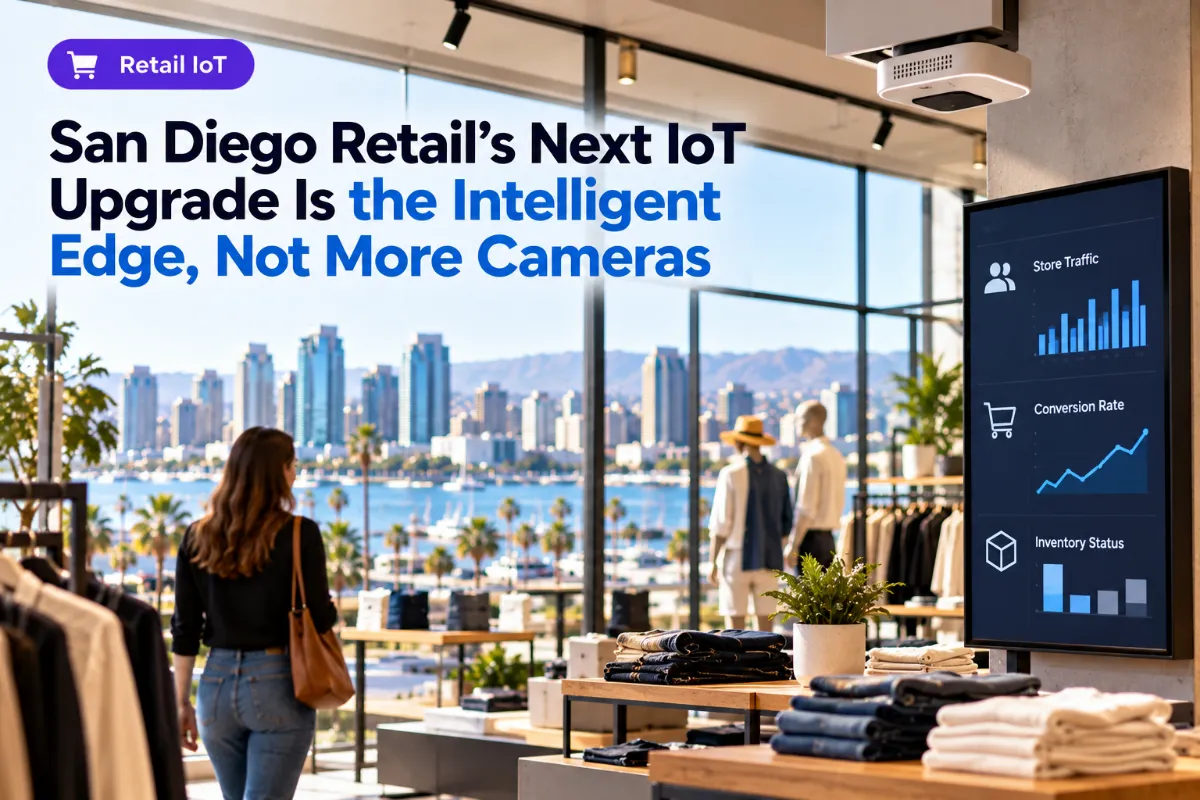
The industry has shifted meaningfully away from facial recognition and biometric identification toward what's often called skeleton tracking or heat mapping, technology that identifies human shapes and movement patterns without capturing or storing any personally identifiable information. Processed at the edge, meaning the analysis happens on local hardware rather than sending video data to the cloud, this approach delivers much of the operational value retailers want without the compliance risk.
The core technology stack San Diego retailers are deploying includes:
- RFID-tagged inventory providing item-level visibility across the sales floor and stockroom, allowing real-time stock accuracy that dramatically outperforms periodic manual counts.
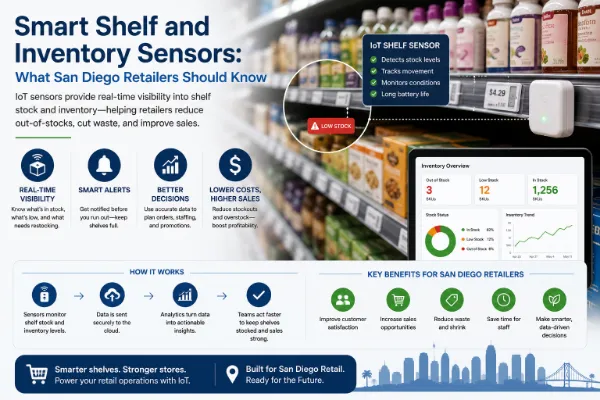
- Smart shelf weight sensors that detect when product is picked up or running low, automatically triggering restocking alerts and, for higher-value items, flagging unusual removal patterns that may indicate theft.
- Electronic shelf labels that update pricing and promotional information across an entire store in seconds, useful for San Diego retailers managing seasonal or tourist-driven pricing strategies without the labor cost of manual price changes.
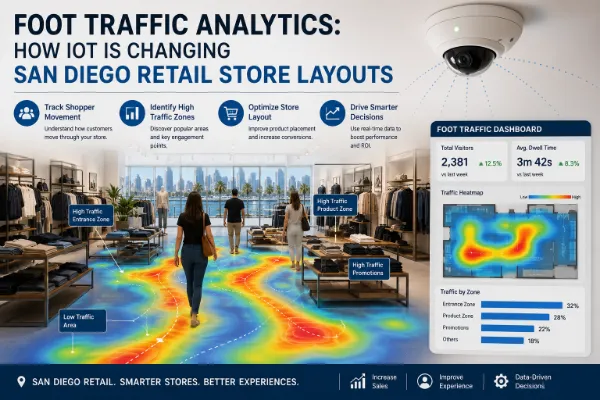
- Anonymized foot traffic analytics using non-biometric sensors to understand which areas of a store draw the most engagement, informing layout decisions without identifying individual shoppers.
- Cold chain monitoring for grocery and specialty food retailers, tracking temperature across refrigerated and frozen sections to catch equipment failures before spoilage occurs.
For San Diego retailers, the financial case for this technology rests on a few well-documented benefits that apply regardless of store size or category.
- Reduced out-of-stock losses. Inventory distortion, the combined cost of out-of-stocks and overstocks, costs retailers billions of dollars annually industry-wide. RFID-based systems commonly push inventory accuracy well above what manual counting methods achieve, directly reducing lost sales from items that are actually in the store but not visible or trackable in the point-of-sale system.
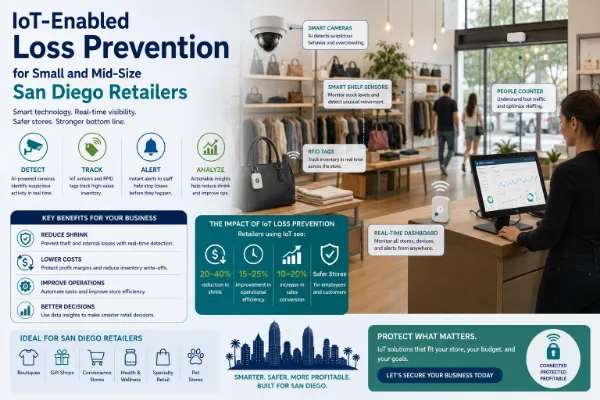
- Reduced shrinkage. Combined RFID and smart shelf systems have shown measurable reductions in shrinkage from both theft and administrative error, since real-time visibility makes discrepancies apparent far faster than periodic inventory audits.
- Labor efficiency. Automated stock counting and restocking alerts free store associates from manual inventory tasks, allowing San Diego retailers facing high labor costs to redirect staff toward customer service, particularly valuable during the county's peak tourist seasons.
- Support for omnichannel operations. Accurate, real-time inventory visibility is a prerequisite for reliable buy-online-pickup-in-store and local delivery promises, both increasingly expected by San Diego shoppers.
- Start with your highest-shrinkage or highest-stockout category. Rather than instrumenting an entire store, identify the specific product categories where inventory inaccuracy is costing the most in lost sales or theft.
- Choose privacy-by-design technology from the outset. Evaluate any camera-based analytics vendor specifically on how they handle data, whether video is processed locally versus sent to the cloud, and what data is actually retained, before committing to a platform.
- Pilot electronic shelf labels alongside smart shelf sensors in a single department to validate both the operational workflow and staff adoption before a full rollout.
- Integrate inventory data with your point-of-sale and e-commerce systems early, since the value of real-time inventory visibility depends on that data actually reaching the systems customers and staff interact with.
- Expand to additional store locations or departments once the pilot has demonstrated measurable improvement in stock accuracy or shrinkage reduction.
Vendor privacy claims that don't hold up to scrutiny. Not every vendor marketing "privacy-friendly" analytics actually processes data at the edge or avoids biometric identification entirely. Retailers should ask specific, technical questions about data handling, not just rely on marketing language, before signing a contract.
Pilot purgatory. A common failure pattern involves testing smart shelf technology successfully in one store, then discovering the system doesn't scale efficiently due to battery management, network infrastructure, or integration challenges across multiple locations. Retailers with multiple San Diego locations should evaluate scalability requirements during the pilot phase, not after.
Return on investment timelines. Retailers sometimes expect immediate results, but realizing the full value of inventory accuracy improvements typically takes a full sales cycle or season to measure properly, particularly for San Diego retailers with significant seasonal or tourism-driven demand variation.
Staff training and adoption. Technology that requires store associates to change established workflows needs adequate training investment, or the system's data quality suffers from inconsistent use, undermining the accuracy gains the technology is meant to deliver.
The next phase for San Diego retail technology is likely to center on tighter integration between inventory systems and dynamic, AI-driven pricing, adjusting prices in near real time based on inventory levels, expiration dates for perishables, and local demand patterns, all without requiring identity tracking of individual shoppers. Autonomous mobile robots for inventory scanning, already in use by larger national retailers, are becoming increasingly affordable for mid-size San Diego retail operations as hardware costs continue to decline.
For retailers navigating California's privacy landscape, the clearest path forward is technology that delivers genuine operational value, accurate inventory, reduced shrinkage, better labor allocation, without requiring the kind of identity-linked data collection that creates compliance risk. San Diego's retail sector is increasingly proving that these two goals aren't in tension.
For related coverage, see our guide to smart shelf inventory sensors for San Diego retailers, our overview of IoT loss prevention for small and mid-size San Diego retailers, and our breakdown of foot traffic analytics for San Diego retail store layouts. San Diego-based Petco is among the local retailers with significant experience navigating connected retail technology at scale. Explore more coverage in our Retail IoT category or the San Diego retail IoT hub.
Frequently asked questions
No. RFID and weight-sensor based smart shelf technology tracks products, not people, and does not involve collecting or storing any personal or biometric data about shoppers, which meaningfully reduces the privacy compliance burden compared to camera-based identity tracking systems.
Properly implemented anonymized analytics that process data at the edge and never link movement patterns to an identifiable individual generally falls outside the personal information definitions that trigger the most stringent CCPA obligations, but retailers should still review their specific vendor's data handling practices with legal counsel, since implementation details vary.
Industry data shows RFID implementations commonly push inventory accuracy above 95 percent, compared to accuracy rates well below that for stores relying solely on periodic manual counts and point-of-sale data, though actual results depend on implementation quality and product category.
The value scales with how frequently a retailer changes pricing or runs promotions. Retailers with dynamic or seasonal pricing strategies, common among San Diego's tourist-facing businesses, tend to see faster returns than retailers with largely static pricing.
Ask specifically whether video data is processed locally at the edge or transmitted to and stored in the cloud, whether any biometric or facial recognition capability exists in the system even if not actively used, and what data retention policy applies to any collected information.
Yes. Real-time inventory visibility and foot traffic analytics help retailers anticipate and respond to the sharp seasonal demand variation common in San Diego's tourist-heavy retail corridors, allowing more accurate restocking decisions and staffing allocation during peak periods.
Related articles

 Retail IoT