Retailers have spent years adding cameras, point-of-sale terminals, electronic displays, handheld scanners and inventory systems. The next technology problem is not a shortage of devices. It is that many of those devices still operate as separate islands.
In 2026, the retail IoT conversation is shifting toward the intelligent edge: processing information inside the store so shelves, cameras, associate devices, location systems and checkout technology can contribute to a shared operational picture.
This trend has a strong San Diego connection. Qualcomm, headquartered in the region, used NRF 2026 to demonstrate edge-AI retail systems spanning shelf intelligence, RFID, location, video analytics and associate workflows. The company is positioning local AI as a way to reduce constant cloud dependence while enabling faster in-store decisions.
For San Diego retailers, the useful question is not whether to install more sensors. It is whether existing store data can answer operational questions quickly enough to change what employees do.
A modern store can know when an item was sold, what the camera sees, what an RFID reader detects and where a handheld device is being used. Yet the information may live in different systems.
A shelf can be empty while the inventory database says units remain in stock. The missing products may be in a back room, misplaced, stolen or waiting to be replenished. The business problem is not merely inventory accuracy. It is converting multiple signals into the next action.
Our San Diego Retail IoT hub covers the broader technology category, while this article focuses on what changes when more processing happens locally.
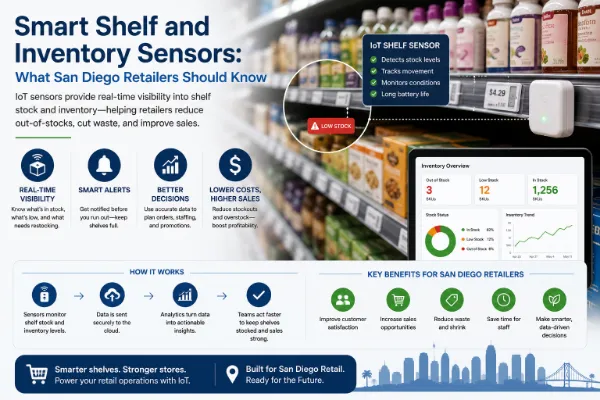
Electronic shelf labels, RFID, cameras and weight or presence sensors can all contribute information about product availability. The intelligent-edge model combines those signals rather than treating each as an independent system.
Qualcomm's 2026 retail demonstrations describe edge shelf intelligence and integrated RFID as parts of a connected store architecture. A local system can potentially identify a shelf condition and route an action to an associate without waiting for a scheduled inventory count.
That builds on the use cases discussed in our smart shelf and inventory sensor guide for San Diego retailers.
| Store Signal | Operational Question | Possible Action |
|---|
| RFID | Is inventory present in the store? | Locate or replenish item |
| Shelf vision | Is the product actually on display? | Create shelf task |
| POS data | How quickly is the item selling? | Prioritize replenishment |
| Foot traffic | Where are shoppers spending time? | Review layout or staffing |
| Queue analytics | Is checkout congestion rising? | Adjust staffing |
Video is a major reason. A store can generate large volumes of camera data, much of which has little long-term business value.
Processing video locally can allow a system to identify an event, measurement or pattern without transmitting every frame to a remote environment. That can reduce bandwidth requirements and support privacy-conscious architectures.
Local processing can also improve response time. A queue-management application is most useful while the queue is forming, not after a batch analytics job runs later.
Traditional video surveillance records what happened. Edge vision systems can attempt to identify events that deserve attention while they occur.
That could include unusual product movement, activity around high-risk areas or discrepancies between checkout and observed behavior. However, automated detection needs careful testing.
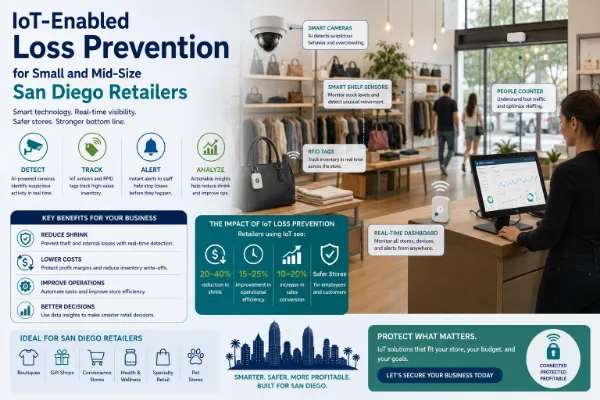
Our existing article on IoT loss prevention for small and mid-size San Diego retailers covers practical deployment considerations. AI adds another requirement: stores need to measure false positives and ensure employees do not treat an automated flag as proof of wrongdoing.
Retail analytics can range from anonymous traffic counts to systems capable of identifying or linking individuals. Those are not equivalent from a privacy perspective.
Stores should begin with the minimum data needed to solve the business problem. If anonymous occupancy information can optimize staffing, collecting identity may be unnecessary.
Our article on privacy-conscious smart shelf IoT in San Diego explores this principle in more detail.
Edge processing can help by allowing some raw information to remain inside the store while only aggregated or event-level data is retained. It does not automatically make a system privacy-safe, but it gives architects more options.
One of the more interesting 2026 developments is the convergence of store IoT and retail media.
Retailers increasingly want to understand whether in-store advertising or digital signage influences actual product engagement and purchases. Qualcomm's intelligent in-store retail architecture describes combining location, shelf interaction and transaction data to create closed-loop attribution.
This moves IoT from cost reduction into potential revenue measurement.
The implementation challenge is avoiding a surveillance-heavy design. Retailers need to decide what can be measured anonymously, what requires consent and which data should never be combined.
Retail AI is often marketed around futuristic shopping experiences. A simpler opportunity is helping employees perform routine work faster.
An associate device could prioritize replenishment tasks, identify where an item is located or summarize inventory exceptions. The business case can be measured in task completion time, shelf availability and reduced searching.
This is particularly relevant to retailers with large stores or complex inventories, where employees spend significant time moving between systems and physical locations.
Counting visitors is easy. Deciding what to do with the count is harder.
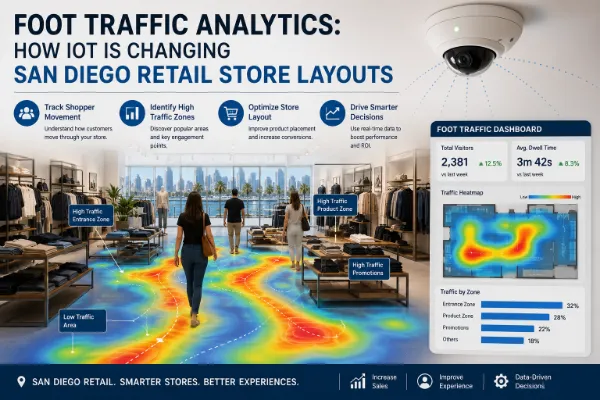
Our guide to foot-traffic analytics for San Diego store layouts explains how movement information can support layout and merchandising decisions.
Edge AI can make this more immediate, but stores should still define the action. Will staffing change? Will a display move? Will checkout capacity be adjusted? If no decision changes, more granular analytics may not create value.
- Choose one measurable store problem. Shelf availability, queue time or inventory search time are stronger starting points than a broad AI initiative.
- Map existing data. Determine what POS, RFID, camera and inventory systems already know.
- Identify the missing signal. Do not buy new sensors if existing systems can answer the question.
- Process locally where it helps. Use edge computing when latency, bandwidth, privacy or continuity justifies it.
- Route the result to an employee. Insights should appear in an existing workflow where possible.
- Measure the business outcome. Compare shelf availability, task time, queue duration or another defined metric before and after deployment.
An intelligent store can use Ethernet, Wi-Fi, Bluetooth, cellular and RFID simultaneously. Each technology serves different devices and data requirements.
The architecture should account for coverage, interference, power consumption and network segmentation. Payment systems, employee devices and experimental IoT sensors should not automatically share unrestricted network access.
Retailers may consume technologies developed far outside the region, but San Diego also contributes to the underlying edge-computing ecosystem. Readers can explore our Qualcomm company profile for local context.
The relevance is not that every store needs a Qualcomm-specific solution. It is that technologies being developed locally are helping redefine what retail endpoints can process on their own.
The intelligent-store model changes the role of IoT. Sensors are no longer valuable simply because they connect. Their value comes from contributing to a local operational decision.
A shelf signal can become a replenishment task. A queue measurement can become a staffing action. A product interaction can inform merchandising. A video event can become a loss-prevention review without requiring every raw frame to leave the store.
For San Diego retailers, this suggests a more disciplined technology strategy. Do not begin with cameras, RFID or AI. Begin with the decision that needs to improve. Then determine which existing signals can support it, what processing belongs at the edge and what information actually needs to leave the store.
The next smart store will not necessarily have the most connected devices. It will be the one where connected devices create the fewest unnecessary steps between a problem and an action.
Frequently asked questions
It is a retail architecture in which store devices and local computing systems analyze some data near where it is generated rather than depending on cloud processing for every task.
Shelf sensors, RFID or vision can help identify when database inventory does not match what shoppers can actually find on the shelf.
Local processing can reduce bandwidth use, support faster alerts and allow some raw video to remain within the store instead of being continuously transmitted elsewhere.
It can provide privacy-conscious design options by processing some information locally, but privacy still depends on what is collected, retained, linked and shared.
Choose a measurable problem such as shelf availability, queue time, inventory search or loss-prevention review and test whether connected data improves that specific outcome.
Use operational metrics such as shelf availability, task completion time, queue duration, inventory accuracy, shrink-related workflows or another measure directly tied to the deployment.
Related articles

 Retail IoT