California's energy compliance landscape has gotten dense enough that San Diego businesses are increasingly discovering IoT monitoring not as a sustainability nice-to-have, but as the only practical way to keep up with overlapping reporting requirements that carry real financial penalties. Between the 2025 Title 24 energy code taking effect January 1, 2026, the statewide AB 802 benchmarking mandate, and the City of San Diego's own local benchmarking ordinance, a commercial property owner in this region is now managing at least three separate compliance obligations that all, not coincidentally, depend on the same underlying energy performance data. Connected sensors and automated reporting platforms have become the practical way to generate that data continuously rather than reconstructing it manually every time a deadline approaches.
Title 24, Part 6 (Building Energy Efficiency Standards): The 2025 code cycle, effective for permit applications filed on or after January 1, 2026, represents the strictest version yet of California's building energy code, and thanks to AB 130, this cycle will remain in effect for a full six years rather than the usual three. It expands mandatory heat pump requirements for HVAC replacement in existing retail, school, office, and library buildings, tightens envelope and lighting standards, and — notably for IoT purposes — adds demand flexibility requirements that specifically require commercial battery storage systems to demonstrate automatic response to utility price signals or grid conditions. Non-compliance penalties can reach $2,000 per day per violation category, which is a real enough figure to change vendor and contractor conversations.
AB 802 (statewide energy benchmarking): This state law requires commercial and multifamily buildings of 50,000 square feet or larger to benchmark and disclose their energy use annually through ENERGY STAR Portfolio Manager. Like Title 24, it carries penalties up to $2,000 per day for non-compliance, and it applies regardless of whether a building is undergoing any construction activity — this is an ongoing operational obligation, not a one-time project requirement.
The City of San Diego's local Building Energy Benchmarking Ordinance: Layered on top of the state requirement, San Diego's own ordinance requires commercial buildings over 50,000 square feet, and qualifying multifamily buildings, to submit energy data through the same ENERGY STAR Portfolio Manager platform by June 1 each year. Because both the state and local requirements route through the same reporting system, a single well-configured data pipeline can satisfy both simultaneously — which is exactly the pattern IoT monitoring platforms are increasingly built around.
The connection between connected sensors and regulatory compliance isn't abstract — it maps to specific, recurring pain points businesses run into with these rules:
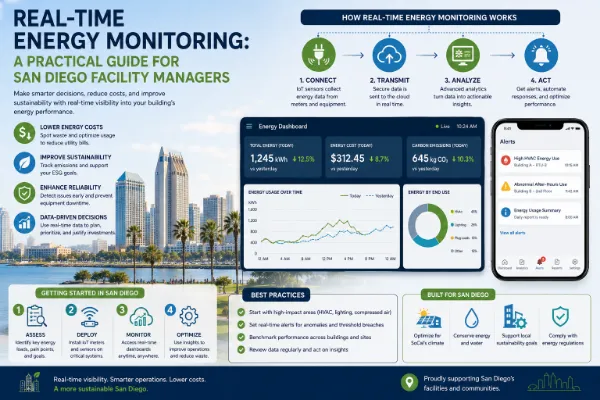
- Automated benchmarking data collection. Rather than a facility manager manually compiling twelve months of utility bills every spring, a monitoring platform with submetering can feed continuously updated, granular energy data directly into Portfolio Manager, satisfying both the state AB 802 and local San Diego ordinance requirements from the same underlying data stream.
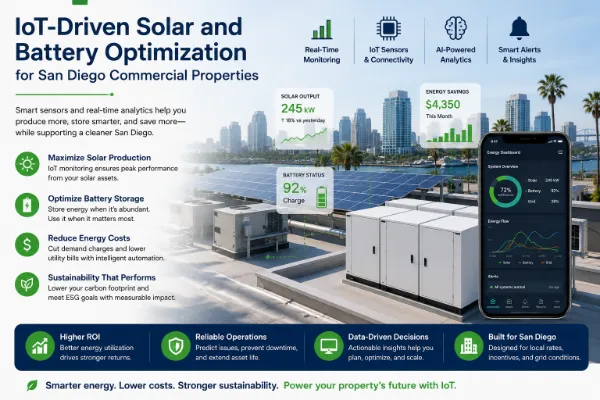
- Demand flexibility documentation for battery systems. The 2025 Title 24 code's requirement that commercial batteries respond automatically to grid signals isn't just a hardware spec — it needs to be demonstrable, which in practice means the battery's control system needs connected, logged evidence of that responsiveness, not just a manufacturer's claim that the capability exists.
- Performance verification after tenant improvements. Because Title 24 compliance requirements apply to tenant improvement projects that touch regulated systems — not just new construction — ongoing monitoring gives building owners a way to verify that a completed TI project is actually performing to its modeled compliance target, rather than assuming compliance based on the design documents alone.
- Audit-ready records. Continuous, automatically logged sensor data creates a defensible paper trail if a compliance question or penalty dispute arises, in a way that periodic manual readings or estimated data simply can't match.
Consider a mid-size San Diego office building over 50,000 square feet undergoing a partial HVAC replacement in 2026. That single project now touches multiple compliance threads at once: the new equipment likely needs to meet the 2025 Title 24 code's heat pump and efficiency requirements if it exceeds certain capacity thresholds; the building's annual energy benchmarking obligation continues uninterrupted throughout the project and needs to reflect the equipment change accurately; and if the owner has also added or is planning battery storage, that system now needs demonstrable demand-flexibility capability under the same code cycle. A single, well-integrated IoT monitoring and submetering deployment covering the building's HVAC and electrical systems can generate the data needed to document all three requirements from one underlying system, rather than juggling separate manual processes for each — which is increasingly the practical argument facility teams are making internally to justify the upfront monitoring investment.
A common and costly misunderstanding is treating these three compliance obligations as separate projects requiring separate solutions. In practice, they're different reporting layers sitting on top of largely the same underlying energy performance data, and businesses that build their monitoring infrastructure around that overlap — rather than bolting on a new point solution for each individual requirement as it comes up — end up with both lower total cost and less administrative burden. It's also common for businesses to underestimate how CALGreen (Title 24, Part 11), which works alongside the energy code and covers broader green building requirements including construction waste diversion and water efficiency, adds yet another layer of documentation that a well-structured facility data platform can help track, even though it's not primarily an energy metric.
Given how interconnected these three compliance layers have become, it's increasingly common for San Diego businesses to bring in a single energy consultant or systems integrator familiar with all three — Title 24, AB 802, and the local ordinance — rather than treating them as separate specialties handled by separate vendors. This matters practically because a contractor focused purely on Title 24 permit compliance for a construction project may not be thinking about how the resulting building systems will feed into an ongoing annual benchmarking obligation, and a benchmarking consultant focused purely on the annual reporting cycle may not fully understand the demand-flexibility documentation requirements a new battery installation needs to satisfy under the current energy code. Asking a prospective vendor directly how their scope of work connects to the other two compliance layers is a reasonable way to surface this gap before signing a contract, not after a reporting deadline reveals it.
For a San Diego business facing these requirements for the first time, a sensible sequence looks like: confirm which specific obligations actually apply to your building based on square footage and building type, since not every property crosses the 50,000-square-foot threshold that triggers both the state and local benchmarking requirements; instrument the systems most relevant to whichever Title 24 compliance path applies to any planned construction or equipment replacement first, rather than a blanket building-wide rollout; and confirm with your chosen monitoring vendor, in writing, that their data export format is actually compatible with ENERGY STAR Portfolio Manager before signing a contract, since not every energy monitoring platform on the market was built with this specific compliance use case in mind.
California's regulatory trajectory points toward tighter integration between these requirements over time, not less — the state's long-term goal of net-zero energy for new commercial buildings by 2030 means each successive Title 24 code cycle is expected to tighten further, and benchmarking and demand-flexibility documentation requirements are likely to expand rather than simplify. San Diego businesses building genuine IoT monitoring infrastructure now, rather than treating each new rule as an isolated compliance fire drill, are positioning themselves to absorb whatever comes in the next code cycle with far less disruption than those starting from scratch each time a new requirement lands.
Frequently asked questions
Buildings over 50,000 square feet are subject to both the statewide AB 802 benchmarking requirement and San Diego's local Building Energy Benchmarking Ordinance. Any building undergoing new construction or a major system replacement is also subject to the current Title 24 energy code.
Yes, in most cases. Because both the state and local benchmarking requirements route through the same ENERGY STAR Portfolio Manager platform, a single well-configured monitoring and data export setup can typically satisfy both simultaneously.
Both Title 24 violations and AB 802 benchmarking non-compliance can carry penalties of up to $2,000 per day per violation category, making continuous, automated compliance tracking considerably cheaper than the risk of falling behind.
The 2025 Title 24 code, effective January 1, 2026, requires commercial battery storage systems to be able to demonstrate automatic response to utility price signals or grid conditions, which in practice requires connected, logged control systems rather than a simple, non-responsive battery installation.
Due to AB 130, the 2025 code cycle will remain in effect for six years rather than the typical three, giving businesses a longer planning horizon before the next round of changes.
Yes, if the project affects regulated systems like lighting, HVAC, or building envelope components — Title 24 compliance isn't limited to new construction and applies to qualifying tenant improvement work as well.
Related articles


 Energy & Sustainability