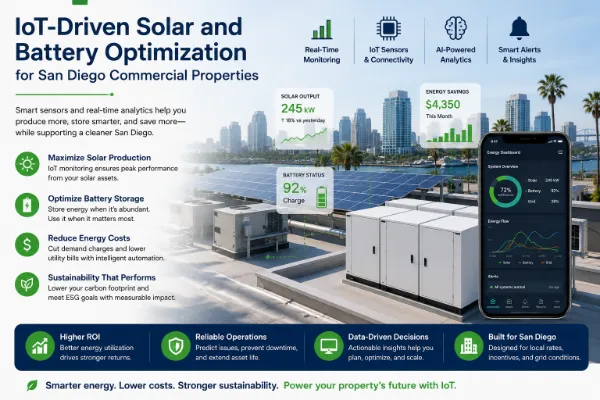
Solar panels on a San Diego commercial roof used to be a fairly simple financial equation: generate power during the day, offset your own usage, and sell whatever's left back to SDG&E at close to retail rates. That equation changed fundamentally under California's Net Billing Tariff, and for commercial property owners specifically, the shift has made the difference between a solar investment that performs well and one that quietly underdelivers largely a matter of software specifically, whether the system's battery dispatch is actually optimized for how the grid values energy hour by hour, or just running on a generic schedule.
Under the old net metering rules, exported solar power was credited at close to the retail rate a customer would otherwise pay often 30 to 35 cents per kilowatt-hour. The Net Billing Tariff replaced that with compensation based on the grid's actual avoided cost at the specific hour the power is exported, calculated through the California Public Utilities Commission's Avoided Cost Calculator. In practice, that's cut average export compensation by roughly 75%, down to something in the range of 8 cents per kilowatt-hour for most daytime exports precisely when solar panels are producing the most power.
The wrinkle that makes this genuinely interesting from an IoT perspective is that avoided-cost export rates aren't flat. They spike, sometimes dramatically, during specific windows when the grid is under real stress late summer weekday evenings between roughly 6 and 8 PM have shown export rates several multiples higher than the daily average in recent years. A commercial property exporting solar at a fixed time or a naive schedule captures none of that upside. One that can dynamically shift battery discharge to align with those specific high-value windows captures meaningfully more value from the exact same physical solar and battery hardware.
For a commercial system, this comes down to a few connected layers working together rather than any single device:
- Real-time load monitoring. Submetered, circuit-level visibility into what the building is actually consuming right now, not an estimate this is the input the dispatch logic needs to decide whether stored energy should serve the building directly or get exported.
- Rate and export-price awareness. The system needs current time-of-use pricing and, ideally, forward-looking avoided-cost rate data so it can plan discharge timing ahead of a known high-value window rather than reacting after the fact.
- Automated, rules-based dispatch. Software that continuously decides, based on the above, whether to store, self-consume, or export at any given moment adjusting automatically as conditions change through the day rather than following a fixed, pre-programmed schedule that can't adapt to an unusually hot afternoon or an unplanned demand spike.
- Weather and production forecasting. Anticipating tomorrow's solar output based on forecast conditions lets the system plan battery state of charge more intelligently overnight, rather than starting each day from a default assumption.
None of these pieces is exotic technology on its own. What makes the difference is integration a system where load data, pricing data, and battery control are actually talking to each other in real time, rather than a battery running its own internal logic disconnected from what's actually happening on the meter.
Residential-scale data offers a useful, if imperfect, proxy for the value at stake: well-optimized solar-plus-storage systems commonly show monthly savings roughly 30-35% higher than solar-only systems facing the same export rate environment, and storing midday solar for evening self-consumption avoids buying peak-hour grid power at rates that can run four to five times higher than what that same energy would earn as an export credit. For a commercial property with a larger, more complex load profile, the absolute dollar impact scales up substantially, and the case for active, IoT-driven optimization over a static, pre-set discharge schedule gets correspondingly stronger.
It's also worth noting that California's 2025 Title 24 energy code, effective for permits filed starting January 1, 2026, adds new demand flexibility requirements for commercial battery systems building owners must now be able to demonstrate that battery systems can automatically respond to utility price signals or grid conditions, which effectively pushes commercial solar-plus-storage projects toward exactly this kind of IoT-connected, dynamically responsive dispatch as a baseline expectation rather than an optional upgrade.
SDG&E business customers were moved onto the Solar Billing Plan structure starting in 2026 for new interconnections and for legacy customers whose 20-year net metering agreements have expired, meaning the pool of San Diego commercial properties operating under NBT-style export economics continues to grow every year. Combined with SDG&E's roughly 10% commercial rate increase in 2026, the gap between what self-consumed solar saves and what exported solar earns has widened further, reinforcing the same conclusion: for most San Diego commercial properties installing or retrofitting solar-plus-storage today, the battery's dispatch intelligence is doing as much financial work as the physical hardware itself.
Self-Generation Incentive Program funding remains available to help offset the upfront cost of adding battery storage to a commercial solar installation, with equity resiliency provisions offering enhanced rebates for certain qualifying properties worth investigating specifically alongside any optimization software evaluation, since the rebate economics and the ongoing dispatch value compound rather than substitute for each other.
Given how much of the value described above depends on software rather than hardware, San Diego property owners evaluating solar-plus-storage vendors should push past generic marketing claims about "smart" battery management and ask specific, verifiable questions: does the dispatch algorithm use your utility's actual current Avoided Cost Calculator rate schedule, or a generic, non-location-specific pricing model? How frequently does the system re-evaluate its dispatch strategy continuously, hourly, or only once a day? And can the vendor show historical performance data from a comparable San Diego commercial property, rather than only theoretical modeling? A vendor unable to answer these clearly is often selling a battery with a basic default schedule rather than a genuinely optimized, IoT-connected dispatch system, even if their marketing language doesn't make that distinction obvious.
- Undersizing the battery relative to the building's actual peak load. A battery too small to cover a meaningful share of evening peak demand limits how much optimization software can actually accomplish, regardless of how sophisticated the dispatch logic is.
- Treating the optimization software as a one-time setup rather than an ongoing service. Avoided-cost rates and utility rate structures change periodically, and a system running on rules configured at installation and never revisited tends to drift away from optimal performance over time.
- Sizing solar production purely to annual usage without planning for export-rate timing. A system generating far more than the building consumes at midday, when export rates are lowest, captures less value than a right-sized system paired with a battery that shifts that same energy to a higher-value window.
- Skipping submetering. Without granular, real-time visibility into actual building load, dispatch software is working with incomplete information and can't make fully informed store-versus-export decisions.
As California's regulatory environment continues pushing toward grid-interactive, demand-flexible battery systems as a baseline requirement rather than a premium feature, the distinction between "having solar and storage" and "having intelligently optimized solar and storage" is likely to keep widening. For San Diego commercial property owners, the practical takeaway is straightforward: the physical hardware decision how many panels, how large a battery is only half the investment. The other half is whether the system connecting that hardware to real-time load, pricing, and grid condition data is actually doing its job, and that's increasingly the piece worth the most scrutiny during vendor selection.
Frequently asked questions
Average export compensation has dropped by roughly 75% compared to the previous net metering structure, from retail-rate credits around 30-35 cents per kilowatt-hour to avoided-cost rates averaging closer to 8 cents.
Battery storage isn't strictly required, but it significantly improves the economics under current rules, since it allows a property to shift self-generated solar to cover expensive peak-hour grid consumption rather than exporting it at a much lower rate.
IoT-driven dispatch integrates real-time building load data, current utility pricing, and often weather-based production forecasting to continuously decide whether to store, self-consume, or export energy, rather than following a fixed, pre-set schedule.
The 2025 Title 24 code, effective for permits from January 1, 2026, includes new demand flexibility requirements for commercial battery systems, requiring them to be able to respond automatically to utility price signals or grid conditions.
California's Self-Generation Incentive Program has offered funding to help offset battery storage costs, including enhanced rebates for certain qualifying properties, though availability and terms should be confirmed as programs are updated.
It can be. Producing significantly more than a building consumes at midday, when export rates are typically lowest, captures less value than a right-sized system paired with a battery that shifts that same energy to higher-value evening hours.
Related articles

 Energy & Sustainability