San Diego Gas & Electric customers pay some of the highest commercial electricity rates in the continental United States, a fact that shapes nearly every energy decision a local business makes. For years, the response was simple: install solar, cut the utility bill, and move on. That playbook is changing. A growing number of San Diego commercial property owners, from Sorrento Valley office parks to Otay Mesa distribution centers, are discovering that solar, battery storage, and EV charging infrastructure connected through IoT platforms aren't just cost-reduction tools anymore. Managed correctly, they're revenue-generating assets in their own right.
This shift matters specifically in San Diego because of the region's unique combination of high electricity rates, aggressive time-of-use pricing structures from SDG&E, and California's demand response programs, all of which reward businesses that can shift and optimize energy use intelligently rather than simply consuming less of it.
SDG&E's time-of-use rate structure creates a wide gap between on-peak and off-peak electricity pricing, with peak periods typically falling in the late afternoon and early evening when demand is highest. A business that runs its HVAC, EV chargers, and battery discharge on a fixed schedule, rather than one that responds dynamically to these price signals, is leaving money on the table every single day.
IoT-connected energy management systems solve this by continuously monitoring real-time pricing signals, on-site generation, and battery state of charge, then automatically shifting load and discharge timing to capture the highest value. For a mid-size commercial property, the difference between static and dynamic energy management commonly represents thousands of dollars annually, and for larger industrial or distribution facilities, the number climbs significantly higher.
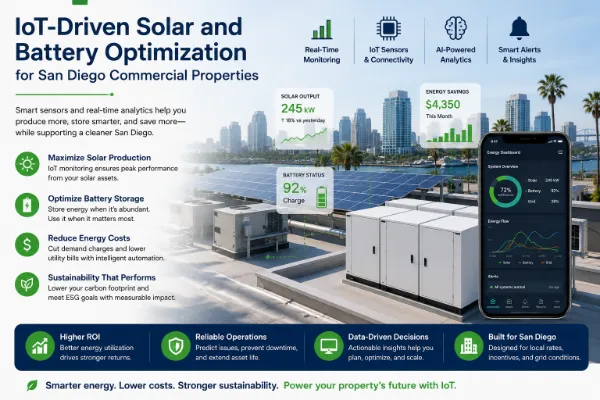
Basic solar installations simply offset consumption during daylight hours. IoT-connected inverters and monitoring platforms go further, providing panel-level performance data that catches underperforming strings or degraded panels long before a manual inspection would. For San Diego properties with rooftop arrays exposed to marine layer haze in coastal zones or dust accumulation in inland areas, this granular monitoring directly protects the return on a solar investment that often represents a six or seven-figure capital outlay.
Battery storage is where the revenue opportunity becomes most tangible. IoT platforms managing commercial battery systems can automatically charge during low-cost off-peak hours and discharge during SDG&E's expensive on-peak window, a strategy known as peak shaving that directly reduces demand charges, often the single largest line item on a commercial electricity bill. Beyond peak shaving, connected battery systems can participate in California's demand response programs, effectively getting paid to reduce grid draw during periods of system-wide stress, turning a cost-avoidance asset into an active income stream.
As commercial properties across San Diego add EV charging to attract tenants and comply with evolving California building requirements, the charging infrastructure itself has become something that needs active management rather than passive installation. IoT-connected charging networks allow property managers to throttle charging speed based on real-time grid conditions, bill tenants or employees accurately for actual usage, and avoid the demand charge spikes that come from multiple vehicles charging simultaneously at full speed during peak hours.
For a San Diego facility manager or property owner evaluating this investment, the relevant metrics fall into a few categories:
- Demand charge reduction. Peak shaving through intelligently managed battery discharge commonly reduces demand charges by 20 to 40 percent for commercial properties with meaningful load variability.
- Demand response revenue. Businesses enrolled in California demand response programs and equipped with automated, IoT-managed load-shedding can generate recurring payments simply for maintaining the capability to reduce draw when called upon, regardless of whether an event is ever triggered.
- Avoided rate escalation exposure. As SDG&E rates continue their upward trajectory, businesses with dynamic, automated energy management are structurally insulated from a larger share of that increase than those on fixed consumption patterns.
- Extended asset life. Panel-level solar monitoring and battery health tracking catch degradation early, protecting the lifespan of capital equipment that's expected to perform for 15 to 25 years.
Businesses that successfully deploy this technology tend to follow a deliberate sequence rather than trying to optimize everything simultaneously.
- Start with real-time monitoring before adding automation. Install metering and monitoring across solar, battery, and major loads first, and spend at least one full billing cycle understanding actual usage patterns before automating anything.
- Identify the highest-value optimization first. For most San Diego commercial properties, that's demand charge reduction through battery peak shaving, since it delivers the fastest, most measurable savings.
- Enroll in applicable demand response programs once automated load-shedding capability is verified and reliable, since enrollment typically requires demonstrating consistent performance.
- Layer in EV charging management as charging infrastructure expands, integrating it into the same platform managing solar and battery assets rather than running it as a separate system.
- Review and recalibrate quarterly, since SDG&E rate structures and demand response program terms change periodically, and a system optimized for last year's rates may be leaving savings on the table today.
Underestimating integration complexity. Properties with solar, battery, and EV charging from different vendors often discover the systems don't communicate natively, requiring a separate energy management platform to unify them. Scoping this integration before purchase avoids a costly retrofit.
Misjudging battery sizing. Battery systems sized purely to cover a facility's average load, without accounting for peak demand spikes, underdeliver on demand charge reduction. Right-sizing requires actual interval data, not estimates.
Compliance and interconnection timelines. SDG&E's interconnection process for battery and expanded solar systems can take longer than businesses expect, and delays here directly push back the timeline for realizing savings. Building this into project planning from the start prevents budget surprises.
Cybersecurity of connected energy assets. As these systems become internet-connected and capable of controlling physical infrastructure, they also become a target. Businesses should confirm vendors follow basic security practices such as encrypted communications and segmented networks before deployment.
The next phase for San Diego's commercial energy landscape centers on aggregation. As more properties deploy IoT-managed batteries and EV charging, third-party aggregators are beginning to bundle these distributed assets into virtual power plants, pools of small, connected resources that collectively behave like a traditional power plant from the grid's perspective. This creates additional revenue opportunities for individual property owners who participate, effectively getting paid for the flexibility their battery systems can offer without giving up control of their own operations.
California's continued push toward renewable integration also means the value of dispatchable, flexible load is only going to increase. Businesses that build the IoT infrastructure now, monitoring, automation, and demand response participation, are positioning themselves to capture that value as it grows, rather than retrofitting under pressure once the financial case becomes impossible to ignore.
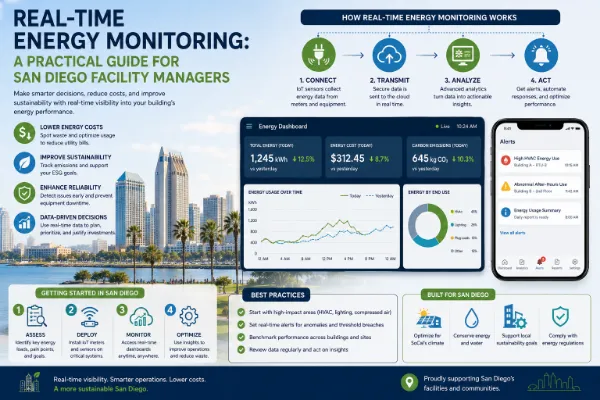
For related deployment guidance, see our detailed look at solar and battery optimization for San Diego commercial properties and our real-time energy monitoring guide for facility managers. Businesses navigating regulatory requirements should also review California energy compliance considerations for San Diego businesses. Explore more coverage in our Energy & Sustainability category or the San Diego energy and sustainability hub.
Frequently asked questions
Beyond reducing a business's own electricity costs, IoT-managed battery systems can enroll in demand response programs that pay businesses to reduce grid draw during periods of system stress. Some aggregation programs also compensate property owners for making their battery's flexibility available to the broader grid, creating a recurring income stream independent of the property's own energy use.
The economics improve significantly for properties with demand charges as a meaningful part of their electricity bill, which typically means larger commercial, industrial, or multi-tenant properties rather than small single-tenant offices. That said, smaller businesses with variable, spiky load profiles can still see meaningful demand charge reduction from a right-sized battery system.
No. Most IoT energy management platforms are designed to integrate with existing solar inverters and can be layered onto an installed system, though panel-level monitoring depth depends on the inverter technology already in place.
Given SDG&E's demand charge structure and time-of-use rate spreads, many San Diego commercial properties see payback within three to six years on battery investments, with demand response program participation shortening that timeline further where enrollment is available.
Unmanaged EV charging can create significant demand charge spikes if multiple vehicles charge simultaneously at full speed. IoT-managed charging that staggers or throttles charging based on real-time grid and pricing conditions substantially reduces this risk while still meeting tenant or employee charging needs.
Properly configured battery systems with IoT management can be set up to island the property from the grid during an outage, continuing to power critical loads. This capability depends on system design and inverter configuration, so it should be specified explicitly during installation rather than assumed.
Related articles

 Energy & Sustainability